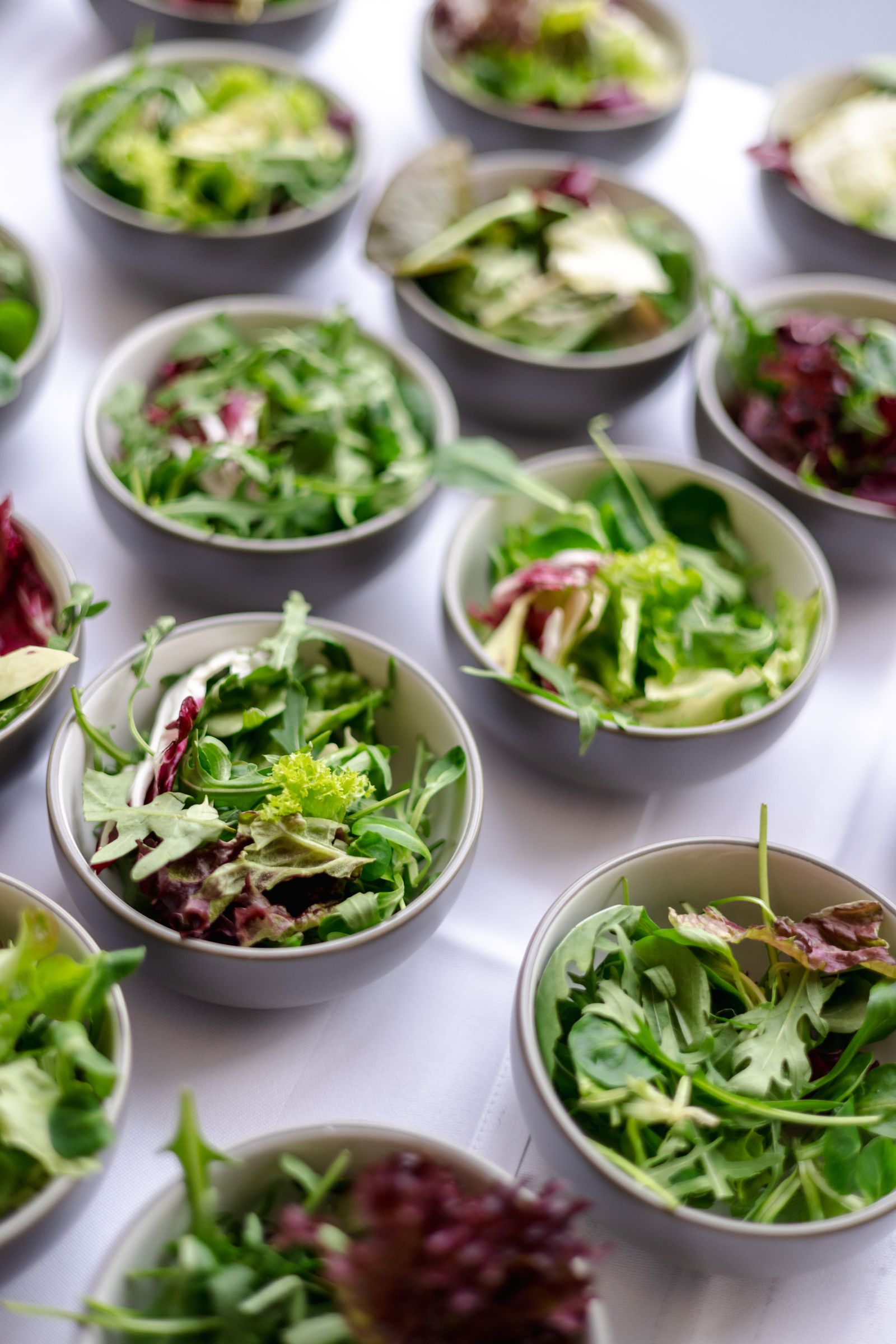
Plant-based provision is one of the few pantry topics where the loudest advice and the actual requirement point in different directions. The advice says transform the pantry. The requirement, in a typical UAE office, is that a handful of people need a reliable oat milk, a slightly larger group avoids meat at lunch some of the time, and one person has a dairy allergy that is a medical issue rather than a preference.
Offices tend to get this wrong in two directions at once. At events they over-cater — ordering a full parallel vegan menu for a group where three people needed it, most of which is thrown away. In the daily pantry they under-provide — no plant milk at all, or one carton that runs out on Tuesday and is not replaced until the next delivery.
Both are sizing problems, not philosophical ones. This is a guide to sizing it properly.
Who is actually asking
Before changing anything, separate four groups that get lumped together and have genuinely different requirements.
People with a medical requirement. Dairy allergy, lactose intolerance, coeliac disease. This group is small and non-negotiable. What they need is not variety but certainty: a product that is reliably present, reliably labelled, and not cross-contaminated. Running out is not an inconvenience for this group; it means they cannot use the pantry at all that day.
People with a religious or ethical position. Vegetarians and vegans. In a UAE office this group is often larger than a European average because of the workforce mix, and in particular a significant Indian-origin population where vegetarianism is common and long-standing. This matters practically: the requirement is usually vegetarian rather than vegan, and it is a firm requirement rather than a preference.
People reducing rather than eliminating. The largest group by far. They will take the plant-based option some of the time and the standard option the rest. Crucially, they do not need dedicated provision — they need the plant-based option to exist and to be good enough to choose.
People with no requirement at all, who will eat a good vegetarian dish without noticing it was vegetarian.
The sizing consequence follows directly. The medical and religious groups need guaranteed provision that never runs out. The reducing group needs quality and availability, not quantity. And because the fourth group will happily eat plant-based food that is good, the efficient strategy is almost never a parallel menu — it is making part of the shared provision plant-based by default.
The way to find your actual numbers is to ask rather than estimate, and to ask in a form people will answer. A short anonymous question in an existing survey, with options for medical requirement, vegetarian, vegan, and no requirement, gives you a real distribution in a week. The pantry policy template is the natural home for whatever you decide afterwards.
Start with the milk
If you do one thing, do this one. In practical terms, the overwhelming majority of unmet plant-based demand in a UAE office is somebody who wants a coffee without dairy milk.
It is also the cheapest requirement to meet properly, and the one most commonly met badly. The two failure modes:
Buying a plant milk that does not work in coffee. Standard drinking oat, almond or soy will frequently split in hot espresso, particularly with the harder water common in the UAE, and the result is a curdled drink that puts people off the whole idea. Barista-formulation plant milks exist precisely to solve this — they are stabilised for heat and acidity and they steam properly. The price difference per litre is real and trivial relative to the alternative of an undrinkable coffee.
Treating it as a special order rather than standing stock. One carton in the back of the fridge is not provision. If someone has to ask, or find it empty twice, they stop trying and buy their coffee outside.
Which milk to stock, briefly. Oat is the most reliable all-rounder in coffee and the safest single choice if you are only stocking one. Soy has the highest protein and works well, but soy is a common allergen and should be labelled accordingly. Almond is popular and the weakest performer in hot drinks. Coconut is a strong flavour that some people like and others cannot drink. If you can stock two, oat plus one other covers nearly everyone.
Storage and rotation matter more than for dairy, because plant milks are usually bought ambient and then refrigerated after opening with a much shorter open life than the carton suggests. Label the opening date. The plant-based milk in office coffee guide covers the coffee-specific detail, and the pantry equipment maintenance guide covers why plant milks are harder on automatic machine milk systems and need a stricter cleaning cycle.
Meat alternatives in office catering
Here the picture is more mixed, and honesty serves better than enthusiasm.
Modern meat-analogue products — the burger and mince substitutes designed to imitate meat closely — work well in specific contexts and badly in others. They perform when they are cooked to order and served hot: a catered lunch with a live station, a team barbecue, a hot buffet that is actively replenished. They perform poorly in the contexts most office catering actually uses: sitting on a buffet for ninety minutes, arriving cold in a delivery box, or being reheated the next day. Texture is the reason, and it does not recover.
They are also expensive per portion relative to what they replace, and in the UAE the imported ones carry a further premium.
The alternative that works better in an office setting is usually food that is plant-based without being an imitation of anything: pulses, grains, vegetables and dairy-free preparations that are designed to be eaten at room temperature. A lentil or chickpea salad, a grain bowl, a mezze spread, roasted vegetables, falafel. These hold their quality on a buffet, they travel, they are cheaper, and — the important part — people with no dietary requirement eat them voluntarily, which is what stops you paying for two menus.
Regional cuisine is a considerable advantage here that UAE offices routinely overlook. A standard Levantine mezze table is largely plant-based already: hummus, moutabel, tabbouleh, fattoush, falafel, vine leaves, foul, olives, bread. It is familiar to almost everyone in the office, it is not marked out as special dietary food, and it solves the vegetarian requirement without a separate order. The morning meetings and bakery catering guide covers the equivalent logic for breakfast provision, and the Arabic coffee and dates hospitality guide covers the guest-facing side.
For the daily pantry rather than catered events, the plant-based provision that gets consumed is mostly ordinary: fruit and cut vegetables, nuts and seeds, dried fruit, and snack bars without dairy or gelatine. Nothing about that list needs to be branded as plant-based to work — see the nutritionist-approved snack list and the protein snacks guide for the wider selection.
Four claims that are not the same claim
This is where offices create genuine risk, and it is worth being precise because the words are used loosely in ordinary speech and strictly on a label.
Plant-based is a marketing description with no fixed legal definition. It generally implies no animal-derived ingredients, but it is not a guarantee and it says nothing about cross-contamination.
Vegan is a stricter positioning claim, often certified by a third-party scheme, covering ingredients and usually production. It still does not guarantee an allergen-free line.
Dairy-free is an allergen statement about one specific ingredient. It is the claim that matters medically, and it is the one that must be reliable. Note that dairy-free is not the same as lactose-free: a lactose-free dairy product still contains milk protein and is dangerous for someone with a milk allergy.
Halal is a separate certification concerning permissibility and slaughter, and it is the one most relevant to a UAE workplace generally. A plant-based product is not automatically halal — the common complications are alcohol used as a carrier in flavourings, and animal-derived additives such as some emulsifiers, gelatine and certain enzymes. Equally, a halal product is obviously not automatically vegetarian.
Two of these overlap in a way worth stating plainly: a vegan product is by definition free of meat and dairy, but that does not make it halal-certified, and in the UAE certification is what a compliance conversation will ask for.
The practical rules that follow are short. Never restate a supplier's claim as a stronger one — if the pack says plant-based, do not label the platter dairy-free. Keep the packaging or the supplier specification for anything served unpackaged, because when someone asks whether a dish contains milk the answer must come from a document rather than a memory. And where the requirement is medical, serve the item in its original sealed packaging wherever you can.
The allergen and dietary labelling guide covers the labelling obligations in detail and the halal compliance guide covers certification, which together are the two references to keep with your catering file.
The allergen problem plant-based catering creates
An underappreciated consequence: swapping to plant-based ingredients frequently swaps one allergen for several.
Dairy comes out. Nuts, soy, sesame and gluten very often come in. Cashew is the base of a great many dairy-substitute sauces and cheeses. Soy is in most meat analogues and many plant milks. Sesame is in tahini, and tahini is in a large share of the Levantine dishes that make plant-based catering work in this region. Seitan is wheat gluten.
So a buffet marketed as the safe option for dietary requirements can be, in practice, the most hazardous table in the room for someone with a nut or sesame allergy.
The controls are straightforward.
Label each dish individually, with its allergens, on a card at the dish. Not one sign for the whole table.
Separate serving utensils per dish, and expect them to be moved. Utensils tied or clipped to their dish survive a buffet better than instructions do.
Physically separate the highest-risk items rather than relying on adjacency being noticed.
Tell the caterer the specific allergy, not the category. "One guest has a severe cashew allergy" produces a different kitchen response from "we need vegan options", and only one of them is safe.
For an office with a known severe allergy, an individually packaged and labelled portion prepared separately is the only genuinely reliable approach at a buffet, and it is worth the small extra cost.
Ordering for mixed groups
The efficient pattern, once the sizing logic above is applied, is consistent across event types.
Make the shared provision plant-based by default where quality allows, rather than ordering a parallel menu. A mezze spread, salads, grain dishes and fruit are eaten by everyone. Then add the meat or dairy items as the smaller, additional element rather than the base. This inverts the usual structure and typically reduces both cost and waste.
Guarantee the non-negotiable requirements separately and individually. For the medical and strict-vegetarian cases, a named, packaged, labelled portion set aside before service. This is the part that must not fail, and a buffet cannot guarantee it.
Order the reducing group's share into the shared provision, not as dedicated portions. They will take what is there.
Do not order a full vegan menu for three people. It is the single most common source of catering waste in offices, and it also tends to isolate the people it is meant to serve.
On quantities: the common error is scaling the plant-based order to the number of people who identify as vegetarian or vegan, when in practice the whole room eats the good plant-based dishes and they run out first. Order the shared plant-based items for a substantially larger share of the group than the dietary count suggests, and the meat items for less than a full head count. This also cuts waste, which the food waste reduction guide covers in more depth, and it keeps the per-head numbers in the cost per employee guide from drifting.
Sourcing and shelf life in the UAE
A few region-specific practicalities.
Availability is good and improving, but depth is uneven. Barista oat milk, standard plant milks and the mainstream meat-analogue brands are readily available through UAE distribution. More specialised items — particular vegan cheeses, specific allergen-free bakery — can be intermittent, and a product available this quarter may not be next. If a product is load-bearing for someone's daily routine, ask your supplier to confirm continuity rather than assuming it.
Imported plant-based products carry longer replenishment cycles. A gap in the supply chain shows up as a four-week absence rather than a one-week one. Hold a slightly deeper buffer on the items that matter and agree a named substitute in advance so a stock-out does not become an improvisation.
Watch open life, not just shelf life. Ambient plant milks have a long unopened life and a short refrigerated one after opening. Fresh plant-based prepared foods are frequently shorter-dated than their dairy equivalents. In UAE summer conditions the cold chain from delivery to fridge is the point of failure, and it is worth confirming with your supplier how the delivery is temperature-controlled — the food safety guide covers the receiving checks that catch this.
Check halal certification at the point of sourcing, not at the point of serving. It is a document your supplier either has or does not, and finding out during an event is too late.
Most of the plant-based protein options end up in the fridge rather than on the dry shelf, and the chilled office snacks guide covers how to run that shelf — formats, shelf life and ordering rhythm — alongside the dairy lines.
A plant-based range cannot double as a gluten-free one — seitan is wheat gluten and many meat alternatives use wheat protein as a binder. The gluten-free pantry guide covers which plant proteins are safe.
Salads are often the main lunch for vegetarian and vegan staff, and the salads and crudités guide covers plant-protein bowls, dressings and allergen labelling.
A Levantine breakfast of bread, olive oil, za'atar, olives and vegetables is mostly plant-based, and the olive oil, za'atar and olives guide explains how to stock it.
For the coffee station, the plant milk guide compares oat, soy, almond and pea milk and explains which work best in hot drinks.
The short version
Size the requirement before changing the provision, and separate the four groups: medical requirements that must never fail, religious and ethical requirements that are firm, a much larger group who will simply take a good plant-based option when it exists, and everyone else who will eat it without noticing. Fix the milk first — a barista-formulation plant milk kept as standing stock rather than a special order solves most unmet demand in a UAE office for very little money. Be realistic about meat analogues: they work hot and to order, and poorly on a buffet, while pulses, grains, vegetables and a standard mezze spread work everywhere, cost less and get eaten by everyone. Keep the four claims distinct, because plant-based, vegan, dairy-free and halal mean four different things and only some of them are safety statements. Remember that removing dairy usually introduces nuts, soy, sesame or gluten, so label per dish and separate utensils. Then order by making the shared provision plant-based by default, guaranteeing the non-negotiable cases as individual packaged portions, and never building a parallel menu for three people.
My Healthy Office supplies meat alternatives, dairy and plant-based milks and the wider pantry range to offices across the UAE, with certification and allergen documentation held on file rather than promised. To get your plant-based provision sized against your actual headcount, get in touch with our team.
For ready-to-heat plant-based burgers, nuggets and falafel for team lunches, see the office meat alternatives guide.
For a one-off event, the World Vegan Day office lunch plan has a menu, quantities and a coffee-station checklist.
Frequently asked questions
How much plant-based provision does a UAE office actually need? Less than the discussion around it suggests, and distributed differently. A small group has a medical or firm religious requirement that must be guaranteed and must never run out. A much larger group will take a plant-based option when it is available and good but needs no dedicated provision. The efficient answer is therefore not a parallel menu but making part of the shared provision plant-based by default, plus individually guaranteed portions for the non-negotiable cases. Ask your own staff with a short anonymous question rather than adopting a benchmark, because the mix varies widely between UAE offices.
Which plant milk is best for an office coffee machine? Oat is the most reliable single choice, and specifically a barista formulation rather than standard drinking oat milk. Barista versions are stabilised against heat and acidity, which matters because standard plant milks frequently split in hot espresso, and more so with harder water. Soy performs well and carries the highest protein but is a common allergen and must be labelled. Almond is popular and the weakest in hot drinks. If you can stock two, oat plus one other covers most people. Plant milks are also harder on automatic milk systems, so the machine's cleaning cycle needs to be followed more strictly, not less.
Is plant-based food automatically halal? No. Halal is a separate certification, and a product with no animal ingredients can still fail it — most commonly because alcohol has been used as a carrier in flavourings, or because of animal-derived additives such as certain emulsifiers, gelatine or enzymes. Conversely, a halal product is not automatically vegetarian. In a UAE workplace the practical step is to confirm certification with the supplier at the point of sourcing and keep the documentation on file, rather than inferring it from an ingredients list during an event.
What is the difference between dairy-free and lactose-free? They are not interchangeable and confusing them is dangerous. Lactose-free dairy products still contain milk protein — the lactose has been broken down, but the milk is still milk. Someone with a milk allergy reacts to the protein, so a lactose-free product is unsafe for them. Dairy-free means no milk-derived ingredients at all. For anyone with a medical dairy allergy, dairy-free is the only claim that counts, and it should be verified from packaging rather than from a serving label written in the office.
Do meat substitutes work for office catering? Selectively. Meat-analogue burgers and mince perform when cooked to order and served hot, so they suit a live station or an actively replenished hot buffet. They perform badly in the situations office catering usually involves — sitting on a buffet, arriving cold in a delivery box, or reheated the next day — because the texture does not survive it. They are also more expensive per portion. For most office events, plant-based food that is not imitating meat, such as pulses, grains, roasted vegetables and a mezze spread, is cheaper, holds better and is eaten voluntarily by people with no dietary requirement.
Does plant-based catering create allergen risks? Yes, and it is frequently underestimated. Removing dairy typically introduces nuts, soy, sesame or gluten: cashew underpins many dairy-substitute sauces and cheeses, soy is in most meat analogues and plant milks, sesame is in tahini and therefore in much Levantine catering, and seitan is wheat gluten. A table presented as the safe option for dietary requirements can be the most hazardous one in the room for a nut or sesame allergy. Label each dish individually at the dish, use separate utensils per dish, physically separate the highest-risk items, and tell the caterer the specific allergy rather than the general category.
How do we cater a mixed group without ordering two of everything? Invert the usual structure. Make the shared provision plant-based by default where the quality supports it — salads, grain dishes, mezze, roasted vegetables, fruit — and add meat and dairy items as the smaller additional element. Everyone eats the shared food, so it does not read as separate dietary catering and it does not go to waste. Then handle the genuinely non-negotiable requirements as named, packaged, labelled individual portions set aside before service, because a buffet cannot guarantee them. Ordering a full parallel vegan menu for a handful of people is the main source of catering waste in offices.
Are plant-based products reliably available in the UAE? The mainstream items are — barista oat milk, standard plant milks and the well-known meat-analogue brands are widely distributed. Depth is more uneven for specialised products such as particular vegan cheeses or allergen-free bakery, and availability can change between quarters as import ranges shift. Because replenishment cycles on imported items are longer, a gap tends to last weeks rather than days. If a specific product is load-bearing for someone's daily routine, confirm continuity with your supplier, hold a slightly deeper buffer, and agree a named substitute in advance.