Every office pantry survey produces the same top request, and it is not fruit. It is chocolate. Whatever the wellness brief says, the item that disappears fastest from a UAE pantry between three and four in the afternoon is the small square of something sweet, and an office that does not stock it simply exports the demand to the vending machine, the cafeteria downstairs or a delivery app.
So the question is not whether to stock sweets but how to do it well — and in the UAE "well" has a dimension that pantry guides written for cooler countries never mention. Chocolate has a physical problem here for half the year. It leaves a supplier's warehouse at 18 °C, spends forty minutes in a van at 45 °C, sits on a reception desk in the sun, and arrives at the pantry grey, soft and stuck to its wrapper. The office then puts the next box in the fridge, which creates a different problem. Meanwhile the sugar in the pantry is the one item that HR, the wellness committee and finance all have an opinion about.
This guide takes chocolate and confectionery seriously as a pantry line: the formats that work in an office, the heat rules that keep them intact, the compliance checks specific to sweets, a sugar position that survives contact with real people, and the budget.
Why chocolate deserves a specification, not a whim
Most pantry lines are bought on a specification — the coffee has a bean origin and a roast, the water has a source and a format, the fruit has a delivery day. Chocolate is usually bought as "some chocolate", by whoever is placing the order, from whatever is on offer. The result is a pantry that swings between premium truffles and bulk fun-size bars depending on the week, at a cost nobody has looked at.
A specification for the sweet line answers five questions: what formats, what portion size, what sugar ceiling, what storage and delivery conditions, and what the line may cost per head per month. The rest of this guide takes them in turn. The payoff is not just consistency; it is that chocolate becomes part of the same snack programme as the nuts and the dried fruit and dates, with a place in the rota rather than a place on the counter.
The formats that work in an office
Not every confectionery format suits a shared pantry. The ones that do share three properties: they are individually portioned, they survive being handled, and they can be eaten at a desk in under a minute. In rough order of how often they earn their place:
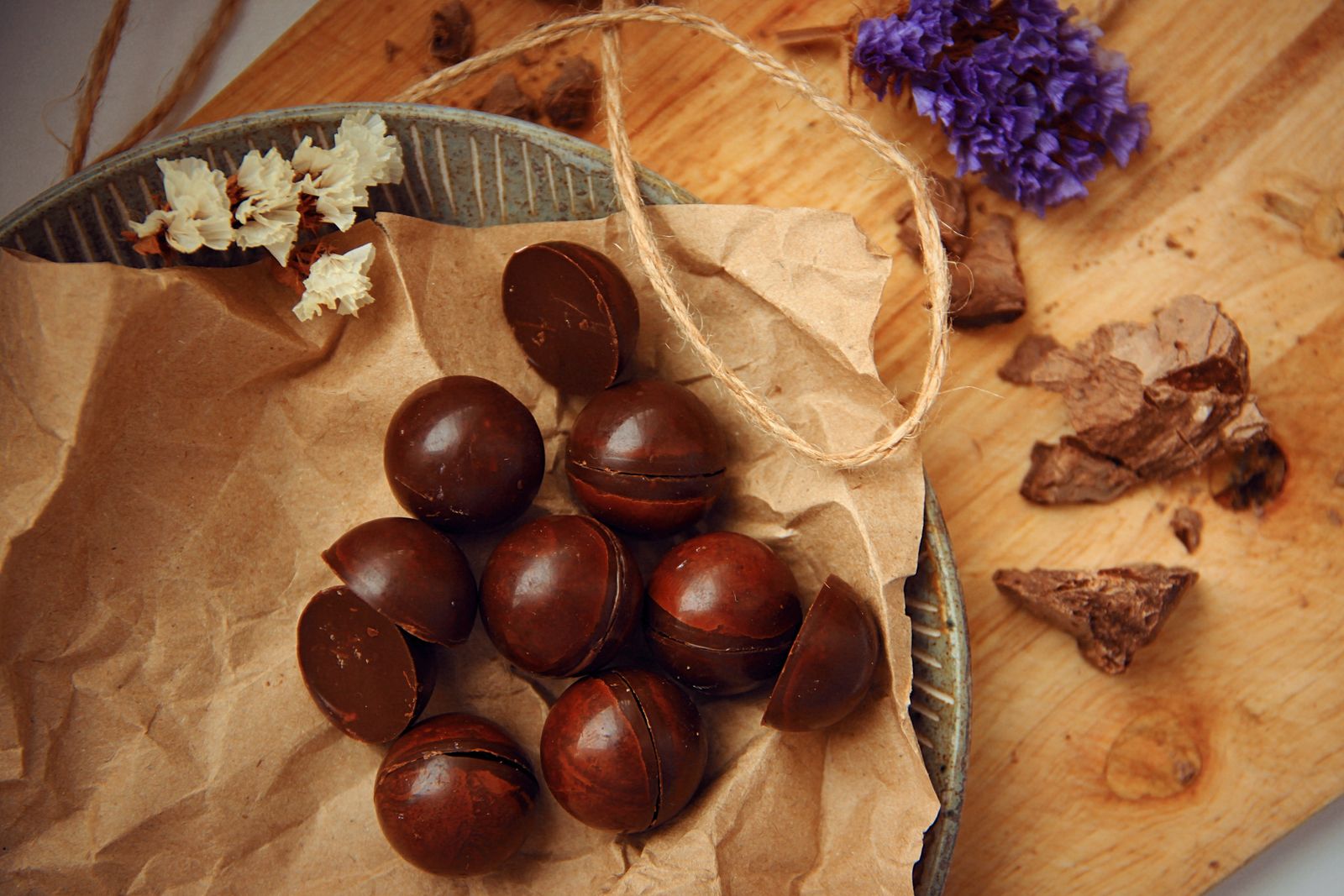
Individually wrapped chocolate squares and napolitains (5–10 g). The single most useful format. A wrapped square is a defined portion, keeps for months, is easy to count and does not need a plate. Dark chocolate at 70 per cent cocoa or above is the sensible default because it is lower in sugar per gram, more satisfying in a small portion and better at surviving warm rooms than milk chocolate. A bowl of wrapped dark squares beside the coffee machine is the pantry equivalent of a good house wine: not exciting, always right.
Mini and fun-size bars (12–25 g). Recognisable brands, popular, and the format most likely to disappear in handfuls. They work well on a two-or-three-days-a-week rota rather than as a permanent fixture. Watch the sugar per unit: a 20 g milk chocolate bar carries around 10–11 g of sugar, which is a reasonable portion; a 45 g "snack size" bar is not a snack size.
Chocolate-coated nuts and dates. The format that is most at home in the UAE. Dark-chocolate-coated almonds and chocolate-covered dates are premium enough for a boardroom, familiar enough for a pantry, and carry protein, fibre or both alongside the sugar. Dates in particular bridge the Arabic hospitality tradition and the sweet break, which is why they are the safest choice for an office that hosts a lot of visitors. Buy them in portion packs rather than open trays; loose coated items in a shared bowl are a hygiene and a waste problem.
Biscuits and cookies. The companion to the tea round, and in offices where karak and tea outsell coffee they outsell chocolate. Individually wrapped two-packs of plain biscuits, digestives and oat cookies are the pantry format; open tins are not. Biscuits are also the line most likely to carry undeclared allergens through shared bowls — see below.
Gummies and chews. Popular with younger teams, cheap per portion, and the format with the most compliance traps: gelatin source, alcohol-based colourings and flavourings, and sugar density well above chocolate's. Stock them in small portion bags, only from suppliers who can show the halal certificate for the specific product, and treat them as an occasional line.
Protein and functional bars. Technically confectionery, practically a meal replacement, and covered in detail in the protein snacks guide. They belong in the snack rota, not in the chocolate bowl, because they are eaten for a different reason.
Premium boxed chocolates and truffles. For the boardroom and for gifting, not for the pantry shelf. Filled chocolates have a shelf life measured in weeks, not months, need cool storage and do not survive a shared bowl with dignity.
The formats that do not work: bulk loose chocolate in a shared bowl, family-size bars left on the counter with a knife, anything that needs a fridge to hold its shape, and anything with a shelf life under a month. Each of these turns into waste, a hygiene question or a single person's afternoon.
The UAE problem: heat, bloom and the fridge
Chocolate is a fat crystal structure, and cocoa butter starts to soften around 28 °C and melts at 32–34 °C — a few degrees below body temperature, which is why it melts in the mouth and why it melts in a Dubai van. From May to October the ambient temperature outdoors is above chocolate's melting point almost every daylight hour, and a loading dock, a van interior or a sunlit reception desk is well above it. Chocolate that has melted and re-set is safe to eat, but it develops fat bloom: the grey-white streaks and dull surface that make a whole box look old. Its texture goes grainy and its snap disappears. Nobody eats it, and the box becomes waste.
The instinctive fix — put it in the fridge — creates the second problem. A cold bar moved into a warm, humid pantry attracts condensation; the moisture dissolves sugar at the surface, which re-crystallises as sugar bloom, a gritty white coating. Fridges also carry odours, and chocolate absorbs them readily. A bar stored next to the hummus tastes of hummus.
The rules that follow, and that belong in the supplier's delivery terms and the pantry's storage instructions:
- Store at 15–20 °C, dry, dark and away from anything aromatic. A cupboard in an air-conditioned pantry is fine; a shelf next to the coffee machine's warm side or in front of a window is not. Most UAE offices are held at 22–24 °C, which is acceptable for dark chocolate and wrapped squares over a few weeks, marginal for milk chocolate over months. Buy accordingly — smaller, more frequent orders in summer.
- The fridge only for a genuine heat emergency, and then correctly. If the air conditioning fails or the pantry runs warm, chocolate can go in the fridge in an airtight container, and it should come out and reach room temperature before the container is opened, so condensation forms on the box rather than on the chocolate.
- Summer delivery in temperature-controlled transport. Between May and October, ask the supplier how chocolate travels. The right answers are a chilled or insulated compartment and a delivery window that avoids the hottest hours. "Same van as the water" is the wrong answer; a case of water does not mind 45 °C and a case of chocolate does. The chilled-chain rules in the fridge snacks guide apply to chocolate in summer even though it is an ambient product the rest of the year.
- Receive it straight into the store. The ten minutes a delivery spends at a security desk or in a loading bay is where most summer chocolate is ruined. Whoever receives the pantry order should move chocolate indoors first, before the water and the paper goods.
- Reject visibly bloomed stock on delivery. It is the clearest sign the chain was broken, and a supplier who cannot deliver chocolate intact in July will not deliver yoghurt intact either.
Shelf life, for planning: dark chocolate keeps 18–24 months from manufacture in good conditions, milk chocolate around 12, white chocolate 6–12, coated nuts and dates 6–12 depending on the fill, filled chocolates and truffles a few weeks. Order the summer months in quantities the office will finish within four to six weeks, rotate first-in-first-out, and keep boxes sealed until they are needed rather than decanting a month's supply into a bowl on day one.
Compliance checks that apply to sweets specifically
Confectionery carries a few compliance questions that the rest of the pantry does not, and they are worth writing into the specification once so nobody has to remember them per order.
Halal status of ingredients, not just the brand. Chocolate itself is rarely a problem, but confectionery ingredients can be: gelatin in gummies and marshmallows (must be from a halal source — bovine or fish — or replaced by pectin), alcohol used as a carrier in some flavourings and colourings, and liqueur-filled or alcohol-flavoured chocolates, which have no place in a UAE office pantry at all. The halal compliance guide for office pantries covers how to ask a supplier for certification at product level and why a brand-level assurance is not enough.
Allergens. Chocolate and biscuits are the densest allergen carriers in the pantry: milk, soy (lecithin), tree nuts, peanuts, wheat and sometimes egg and sesame, frequently with "may contain" traces of the others because they share production lines. Individually wrapped portions carry their own labels, which is the strongest argument for that format over loose bowls. The allergen and dietary labelling guide sets out how to label a shared shelf so that someone with a nut allergy can trust it.
Arabic labelling and import registration. Pre-packaged food sold in the UAE must carry Arabic labelling and be registered through the relevant municipality's food import system. For an office this is invisible when buying through a registered UAE supplier and becomes a problem only when someone brings in a case of imported chocolate from a trip or an online marketplace. Stick to product that has come through a UAE-registered importer; it is also the product that has been stored properly on the way.
Tax treatment. Confectionery is not an excise good — UAE excise applies to tobacco, energy drinks, carbonated and sweetened beverages, not to solid sweets — so chocolate carries VAT at 5 per cent only. That is worth knowing because the tiered sugar excise introduced on drinks in 2026, described in the soft drinks guide, does not reach the chocolate bowl. For the deductibility of staff refreshments generally, see the corporate tax guide and the VAT guide.
A sugar position that survives contact with the office
The chocolate bowl is where a pantry's wellness intentions meet reality, and the offices that get it right have stopped treating it as a binary. Three approaches in rising order of ambition, all of which keep chocolate in the pantry:
Portion, don't prohibit. Set a ceiling on sugar per portion rather than on the category. A practical line is around 10 g of sugar per unit — roughly a 10 g dark square, a 20 g milk mini bar, a portion pack of coated almonds. Anything above that is bought for events, not for the shelf. This single rule removes the 45 g bars and the family blocks without anyone having to be told that chocolate is banned.
Make the default dark. Keep dark chocolate at 70 per cent or above as the always-available line and rotate milk chocolate and other sweets in two or three days a week. Dark chocolate's lower sugar per gram, higher satiety and better heat tolerance make it the right default on all three counts. The low-sugar and diabetic-friendly pantry guide covers why a quiet change of default lands better than a sign, and why a labelled sugar-free option should sit alongside rather than replace the standard one.
Pair sugar with something. Coated nuts and dates, a square of chocolate next to the fruit bowl, biscuits with the tea round rather than in a standalone tin. Sweets consumed alongside protein, fibre or fat behave differently from sweets consumed alone at three o'clock, and the pairing also reduces the number of units that disappear. The nutritionist-approved snack list gives the portions that make this work, and the low-sugar treats range is built for exactly this middle ground.
What does not work: removing chocolate entirely (it comes back within a month, in people's drawers, and the pantry has lost credibility), unlimited supply (the cost is not the problem, the 4 pm crash is), and a "healthy" replacement that nobody wanted (carob is not a substitute for chocolate; a good dark square is).
Occasions: when the sweet line should scale up
Confectionery is the pantry line most tied to the calendar. Four moments where the specification should allow it to flex:
- Ramadan and Eid. Dates, chocolate-covered dates and boxed sweets for iftar and for Eid hampers. The Ramadan gifting guide and the Eid al-Adha pantry planning guide cover timing and quantities.
- UAE National Day in December — see the National Day celebration guide — and Diwali, for which the Diwali office celebration and gifting guide sets out the mithai-and-chocolate hamper conventions.
- Client-facing meetings. A small dish of wrapped dark squares or coated dates in a meeting room is the least effort per impression of anything in hospitality; keep a separate boardroom stock in a cupboard, not in the pantry bowl, or it will be gone.
- Year-end. The Q4 planning guide covers December ordering, which is when the sweet line typically doubles and the storage rules above matter least because the weather finally allows it.
The rest of the year the line should be steady and slightly boring. That is what a specification is for.
Costing the sweet line
Indicative per-unit costs at office-supply quantities, VAT excluded: wrapped dark squares 40–80 fils each; mini and fun-size bars AED 1.00–1.80; portion packs of coated nuts or dates AED 3–6; individually wrapped biscuit two-packs 50–90 fils; premium boxed chocolates AED 60–150 per box for the boardroom. The unit costs are not the issue; the quantity is.
For sizing, a reasonable planning assumption is one sweet portion per person per working day, of which about half is taken. At a blended AED 1.00–1.50 per portion actually consumed, a 100-person office runs to roughly AED 1,000–1,700 a month on the sweet line, or AED 10–17 per head — a small slice of the overall cost per employee and well inside the discretionary band in most pantry budgets. Offices that see the line running at two or three times that figure are almost always suffering from large-format bars or open bowls rather than from high prices.
In summer, add the cost of ordering more often and in smaller quantities, and expect to write off a small amount to heat regardless. That is cheaper than a bloomed carton.
Two efficiencies that make a real difference: put the sweet line on the same weekly delivery as the snacks, nuts and seeds and dried fruits rather than on separate ad-hoc orders, and have it counted in the same inventory routine as everything else. Chocolate is the pantry line most likely to be bought on a personal card because it is the one people most want, and it is also the one that most benefits from being invoiced, tracked and delivered cold.
Who this matters most for
Every office runs a sweet line of some kind, but three settings have a particular reason to specify it properly. Firms with heavy client traffic — the law firms, family offices and consultancies clustered in DIFC, ADGM and Downtown — where the dish in the meeting room is part of the hospitality and coated dates do more work than any brochure. Large sites with long shifts, such as the logistics operations in JAFZA and the manufacturing units of Al Quoz, where a wrapped biscuit and a small chocolate with the tea round are a fixture of the day and where storage is often a warm back room rather than an air-conditioned pantry, making the heat rules above the whole game. And schools and universities, where staff-room sweets sit alongside a duty of care to students and the sugar position has to be written down rather than assumed. The breakfast and corporate events range covers the occasion end; the pantry end is a bowl of good dark squares that never runs out and never blooms.
The short version
Stock chocolate — the office will get it somewhere anyway — but stock it to a specification. Individually wrapped dark squares as the always-on default, mini bars and coated nuts or dates on a rota, biscuits with the tea round, gummies and boxed chocolates only with a halal certificate at product level and only occasionally. Cap the portion at around 10 g of sugar, pair sweets with the fruit and nuts rather than leaving them alone on the counter, and keep a labelled sugar-free option beside the standard one. From May to October, insist on temperature-controlled delivery, move chocolate indoors first, store it at 15–20 °C in a cupboard rather than a fridge, and order in quantities the office finishes in a month. Budget AED 10–17 per head per month and put it on the same invoice as the rest of the snacks.
MHO supplies UAE offices with portion-controlled chocolate, low-sugar treats, coated nuts and dates, wrapped biscuits and the wider office snack range, delivered on the same run as the coffee, water and fruit and in temperature-controlled transport through the summer. Browse the full range by category, see every area we deliver to, or talk to us about a sweet line that fits the office's sugar policy and survives July.
Frequently asked questions
What type of chocolate is best for an office pantry in the UAE? Individually wrapped dark chocolate squares at 70 per cent cocoa or above, in 5–10 g portions. They are lower in sugar per gram than milk chocolate, more satisfying in a small serve, keep for 18–24 months and tolerate a warm room better than milk or white chocolate. Rotate milk chocolate mini bars, chocolate-coated almonds and chocolate-covered dates alongside them two or three days a week. Avoid loose chocolate in shared bowls, family-size bars and anything filled or truffle-style, which needs cool storage and has a short shelf life.
How should chocolate be stored in a UAE office during summer? In a sealed box in a cupboard at 15–20 °C, dry, dark and away from anything aromatic — not on the counter, not by a window and not in the fridge. Cocoa butter softens at around 28 °C and melts at 32–34 °C, and chocolate that melts and re-sets develops fat bloom (grey streaks and a grainy texture). The fridge causes condensation and sugar bloom and lets chocolate absorb odours; use it only in a heat emergency, in an airtight container, and let the container reach room temperature before opening it. Order smaller quantities more often between May and October.
Why did the chocolate arrive grey or white on the surface? Almost always heat during transport or at the delivery point. Grey streaks and a dull, soft surface are fat bloom from melting and re-setting; a gritty white coating is sugar bloom from condensation after a cold-to-warm move. Both are safe to eat but unappealing. In summer, ask the supplier to deliver chocolate in chilled or insulated transport, avoid the hottest hours, move it indoors before the rest of the order, and reject stock that arrives visibly bloomed — it is the clearest sign the delivery chain was broken.
Is chocolate subject to excise tax in the UAE? No. UAE excise applies to tobacco products, energy drinks, carbonated drinks and sweetened beverages, not to solid confectionery. The tiered sugar excise that came into effect on drinks on 1 January 2026 does not apply to chocolate, biscuits or sweets, which carry VAT at 5 per cent only. Chocolate-flavoured drinks and sweetened milkshakes are a different matter and may fall within the beverage rules.
How much should an office budget for chocolate and sweets? Plan for one sweet portion per person per working day, of which roughly half is taken, at a blended AED 1.00–1.50 per portion consumed. For a 100-person office that is around AED 1,000–1,700 a month, or AED 10–17 per head — a small share of total pantry spend. A line running at two or three times that level usually indicates large-format bars or open bowls rather than high unit prices. Add a small allowance in summer for more frequent, smaller deliveries.
Are gummies and marshmallows suitable for a UAE office pantry? Only with care. Both commonly contain gelatin, which must be from a halal-certified bovine or fish source or replaced with pectin, and some use alcohol as a carrier in flavourings or colourings. Ask the supplier for halal certification at product level rather than brand level, buy them in small portion bags, and treat them as an occasional line rather than a daily one — they carry more sugar per portion than chocolate and less of anything else.