In 2026, Diwali's main day — Lakshmi Puja — falls on Sunday 8 November.
That single fact determines almost everything about how a UAE office should plan for it. The UAE working week runs Monday to Friday, so the festival itself lands on a non-working day. The office celebration therefore happens on Friday 6 November, the last working day before it. Corporate gifts need to reach recipients before that, which in practice means the week of 26 October to 5 November. And the wider five-day festival — beginning with Dhanteras a few days ahead of the main day — means the run-up is already underway while your office is still deciding whether to do anything at all.
Most UAE offices do decide to do something, and for good reason. Indian nationals are the single largest expatriate community in the country, and Diwali is also observed by Nepali, Sri Lankan, Jain and Sikh colleagues, with different emphases. For a substantial share of your team this is the biggest festival of their year. Marking it costs very little and is noticed; not marking it is also noticed, particularly in an office that visibly marks other occasions.
This guide is the operational version: dates, catering rules, gifting, building constraints, and the accounting treatment.
The timeline that actually works
Diwali planning fails in a predictable way — everything is left until the week before, at which point the good gift boxes are gone, the caterer is fully booked, and the building has questions about the decorations that nobody has time to answer.
Working backwards from Friday 6 November 2026:
Six to eight weeks out (mid-September to early October). Decide whether you are doing a celebration, gifts, or both, and set the budget. If gifts are going to clients, this is also when the gift-policy question needs answering — see below. Confirm your supplier's cut-off for Diwali gift boxes, because the premium formats are made to order and sell out.
Four weeks out (early October). Place the gift order. Confirm the catering brief with dietary requirements specified rather than assumed. Ask the building management about decorations, open flames and any common-area use — this is the question that takes longest to get an answer to and the one most often skipped.
Two weeks out (last week of October). Client gifts go out from this point so they arrive comfortably ahead. Confirm headcount for the office celebration. Send the internal invitation — clearly framed as an office celebration everyone is welcome at, not an assumption about anyone's faith.
The week of 2 November. Staff gifts distributed. Decorations up early in the week. Final catering numbers confirmed. Any remaining client gifts delivered.
Friday 6 November. The office celebration itself.
The single most common failure is treating the client gifting and the office celebration as one workstream. They have different lead times, different budgets and, in a regulated firm, entirely different approval requirements. Split them at the start.
The catering brief: what most offices get wrong
Diwali catering has more dietary structure to it than most office occasions, and getting it wrong is both visible and easily avoided.
Vegetarian is the baseline, not an option. A large majority of people observing Diwali will expect the food associated with it to be vegetarian, and many who eat meat the rest of the year abstain during the festival. The practical instruction to your caterer is that the Diwali spread is vegetarian by default, with any non-vegetarian items — if you include them at all — clearly separated and clearly labelled. This is the opposite of the usual office arrangement, where vegetarian food is the labelled minority.
Jain requirements go further and are frequently missed. Observant Jain colleagues avoid onion, garlic and root vegetables entirely, which rules out a large part of a standard Indian catering menu including most gravies. If you have Jain colleagues — and in Dubai's trading, jewellery and finance sectors you very likely do — asking the caterer for a small, clearly marked Jain-suitable selection costs almost nothing and is disproportionately appreciated. It is also the sort of specification a caterer will simply not offer unless asked.
Sattvic, no-alcohol and no-gelatine. Diwali food is not an occasion for alcohol in a workplace context, and it should not need saying in a UAE office. Less obviously, gelatine appears in imported sweets and mousse-style desserts and is a problem for vegetarian and Jain colleagues alike — specify vegetarian-set desserts explicitly.
Mithai is very high in sugar, and that is the point. Indian sweets — barfi, ladoo, kaju katli, jalebi, soan papdi — are the centrepiece and there is no sensible way to make them a health food. What you can do is size them properly rather than ordering by weight, offer a fruit and dried fruit platter alongside so people have a middle option, and make sure the sugar-free or reduced-sugar variants exist for colleagues managing diabetes. Any office running a stated low-sugar pantry policy should treat a festival as an explicit exception rather than quietly breaking its own rule.
Nuts and dairy are everywhere in this cuisine. Cashew, pistachio, almond and milk solids are structural to most mithai, not incidental. Allergen labelling matters more here than at almost any other office occasion, and the discipline set out in the allergen and dietary labelling guide should be applied to the sweets table specifically. A card per item, written before the food arrives.
Timing and food safety. Mithai is largely dairy-based and does not sit well in a warm room for a full working day. Treat it the way you would any other perishable catering in a UAE office: put it out for the celebration window rather than at nine in the morning, keep the dairy-heavy items refrigerated until then, and clear the table at a defined time rather than letting it sit until Monday.
Corporate gifting: why it is a box of dry fruit
If you ask what the standard Diwali corporate gift is, the honest answer across India and the Gulf is: dry fruit and nuts, in a presentation box.
This is not a lack of imagination. It is a genuinely well-adapted convention. Dry fruit is universally acceptable across the dietary lines that matter — vegetarian, Jain-suitable in its plain form, halal, no alcohol, no gelatine. It has a long shelf life, so it survives a courier and a desk. It looks substantial. It is easy to scale from a modest staff gift to a serious client gift purely by moving up in grade. And it carries no religious content that would make it awkward to give to a colleague who does not observe the festival — which matters a great deal in a mixed UAE office.
The practical decisions inside that convention:
Grade rather than volume. A smaller box of genuinely good pistachios, cashews, almonds and premium dates reads as considered. A large box of mixed raisins reads as bulk. The dried fruit and dates buying guide covers how grade actually works in this category, and it applies directly to gifting.
Sweets travel badly, dry fruit does not. A mithai box is the warmer, more traditional gift and it has a shelf life measured in days, needs cool transport in the UAE, and cannot sit in a reception until someone collects it. For internal distribution on the day it is excellent. For client gifting by courier across the Emirates it is a risk. Many offices do both: mithai in the office, dry fruit boxes out of the door.
Decide the branding question deliberately. A discreet card is better received than heavy corporate branding on a festival gift. Branded packaging that outlasts the branding is also a waste — the same logic that applies to any corporate gifting programme.
Check your gift policy before you order, not after. Banks, law firms, listed companies, government-facing consultancies and anyone operating under a compliance regime almost certainly has a gifts and hospitality register with a value threshold, and quite possibly a rule about gifts to public officials that has no threshold at all. This catches offices out every year, and it is a five-minute question to compliance in September that becomes a serious problem in November. Firms in banking and financial services and law and professional services should assume there is a policy and go and read it.
Non-food alternatives exist and are worth considering where dietary or policy constraints bite: plants, quality stationery, a charitable donation in the recipient's name. The last of these has become genuinely common and sidesteps the gift-register problem entirely.
The building will have opinions
Two Diwali traditions run into UAE building management, and both are easier to handle early.
Open flames. The diya — the small oil lamp — is the central symbol of the festival, and almost every commercial tower in the UAE prohibits open flames in tenanted space under its fire regulations. This is not negotiable and it is not worth arguing about. LED diyas are widely available, look convincing en masse, and are what most UAE offices use. Confirm the position with building management rather than assuming, particularly in a free zone tower or a multi-tenant floor where the rule may be stricter than the base regulation.
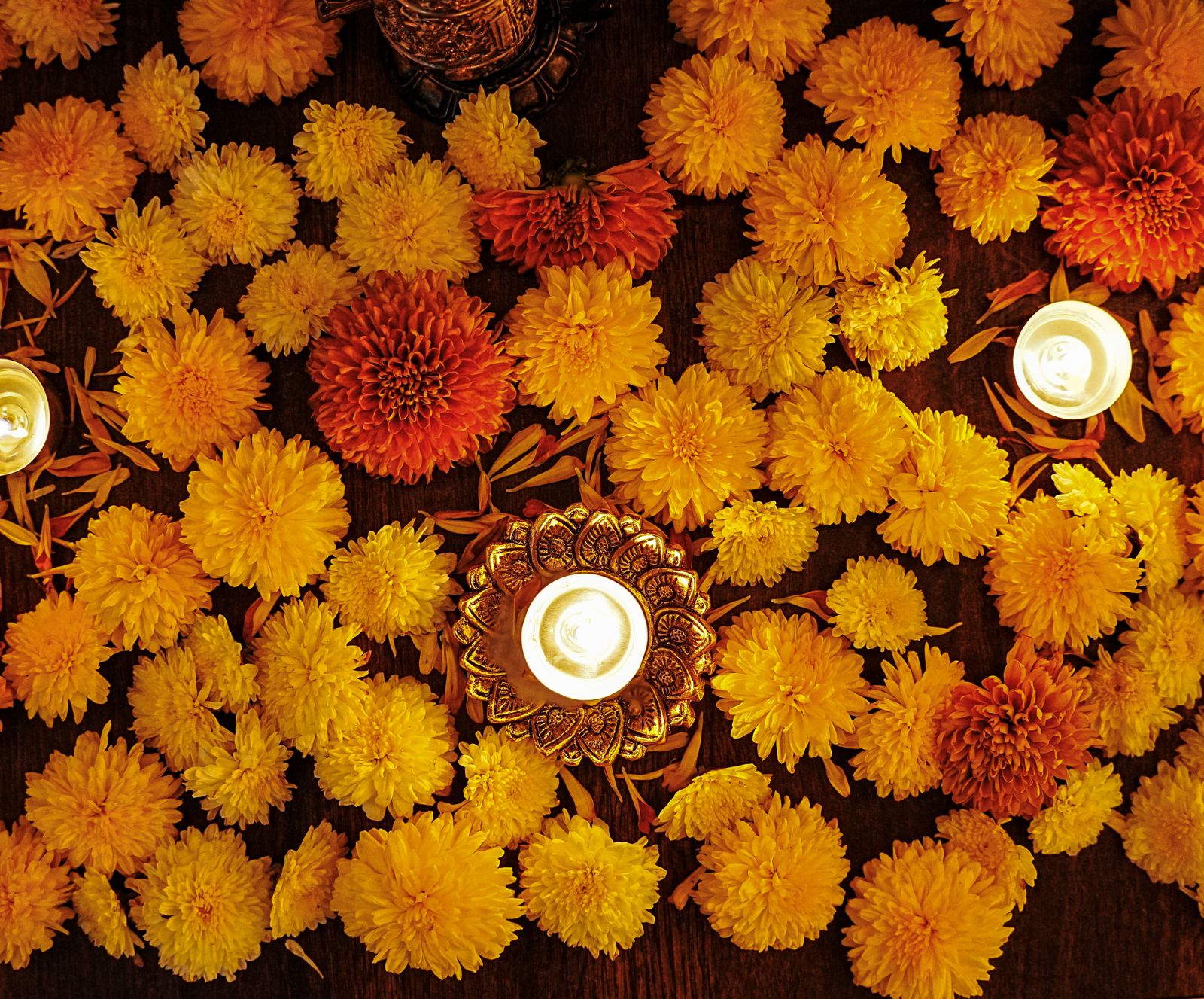
Rangoli. Floor decoration at the entrance, traditionally in coloured powder, is beautiful and creates a real cleaning and slip-hazard conversation with facilities. The workable versions are a rangoli on a board or mat rather than directly on the floor, adhesive floor decals, or a flower-petal rangoli using marigolds, which sweeps up cleanly. Agree it with facilities in advance; discovering the objection on the morning is a poor use of everyone's day.
Marigold garlands, fairy lights and coloured drapes are generally uncontroversial, but check whether anything needs to be fixed to walls or ceilings, and whether the fire strategy has anything to say about hanging fabric. In a shared or coworking space the operator's rules apply rather than yours, and they will want notice.
Inclusion: framing matters more than budget
The framing that works in a UAE office is that this is an office celebration of a festival many colleagues observe, open to everyone, with no expectation attached. It is not a religious observance the company is conducting.
That framing does a lot of quiet work. It makes attendance genuinely optional without anybody having to say so. It makes it comfortable for colleagues who do not celebrate Diwali to come along and enjoy the food. And it keeps the occasion consistent with how the same office marks Ramadan and Eid, UAE National Day and Christmas — which is the actual test people apply. An office that marks one festival elaborately and another not at all will be read accordingly, and that reading is usually correct.
Two practical inclusion points that cost nothing:
- Do not require traditional dress. Invite it, welcome it, and make clear it is optional. Some people will dress up and enjoy it; others will not, for reasons that are their own.
- Ask, do not appoint. Colleagues who celebrate Diwali will often be glad to help shape the occasion. They should not be volunteered to organise it because of their background — that is a well-intentioned pattern that becomes tiring quickly.
Getting these small things right is a meaningful part of why cultural occasions in the office contribute to retention rather than just to the calendar.
The tax treatment
Two separate questions, and offices routinely conflate them.
VAT. Input tax on entertainment provided to non-employees — clients, business contacts, the recipients of your client gift boxes — is generally blocked, so plan on not recovering the VAT on that spend. Staff refreshments and staff celebrations sit differently and the treatment depends on the specifics; the VAT on office pantry and staff refreshments guide sets out how the distinction usually falls, and this is a question to run past your tax adviser rather than to decide from an article.
Corporate tax. Entertainment expenditure carries its own restriction under the UAE corporate tax regime, and staff costs and client entertainment are treated differently. Coding a Diwali celebration and a client gifting programme to the same general expense line makes both harder to substantiate later. The corporate tax treatment of pantry and refreshment spend covers the characterisation.
The administrative point is simple and worth doing at the time rather than at year end: book the staff celebration and the client gifting to separate cost lines, with the invoices retained and the purpose noted. Folding both into the Q4 planning cycle — where the National Day and year-end spend already sits — is the cheapest way to make that happen.
What good looks like
A UAE office that handles Diwali well in 2026 has:
- The celebration on Friday 6 November, planned from six weeks out rather than the week before.
- Client gifting and the office celebration run as two separate workstreams with different budgets and approvals.
- A vegetarian-by-default catering brief, a marked Jain-suitable selection, vegetarian-set desserts, and no gelatine.
- Allergen cards on the sweets table, written before the food arrives.
- Dry fruit boxes for client gifting, mithai for the office on the day.
- The gift policy checked with compliance in September, not November.
- LED diyas, a rangoli agreed with facilities, and building management asked about decorations in advance.
- The occasion framed as an office celebration open to everyone, consistent with how the same office marks Eid, National Day and Christmas.
- Staff celebration and client gifting coded to separate cost lines with the invoices kept.
Diwali is followed closely by year-end gifting, and the year-end corporate gift hampers guide covers timing, budgets, packaging and anti-bribery checks.
The short version
Diwali's main day falls on Sunday 8 November 2026, so the UAE office celebration lands on Friday 6 November and client gifts need to be out of the door in the last week of October. Plan from six weeks out and split client gifting from the office celebration — they have different lead times, budgets and approvals, and in a regulated firm entirely different sign-offs. Brief the caterer vegetarian by default rather than vegetarian on request, ask specifically for a Jain-suitable selection without onion, garlic or root vegetables, insist on vegetarian-set desserts with no gelatine, and put allergen cards on the sweets table because cashew, pistachio, almond and dairy are structural to mithai rather than incidental. Size the sweets rather than ordering by weight, and put a fruit and dried fruit platter alongside so there is a middle option. For gifting, the convention is a dry fruit and nut box because it crosses every dietary line, survives a courier and scales by grade — keep mithai for internal distribution on the day, where its short shelf life is not a problem. Check the gifts and hospitality register in September if you are in a regulated sector. Expect the building to prohibit open flames, so use LED diyas, and agree the rangoli with facilities in advance rather than on the morning. Frame the whole thing as an office celebration open to everyone, consistent with how you mark Eid, National Day and Christmas. And code the staff celebration separately from the client gifting, because VAT and corporate tax treat them differently.
My Healthy Office supplies dried fruits and dates, nuts and seeds, low-sugar treats, juices and waters and breakfast and corporate event catering across Dubai and Abu Dhabi on scheduled delivery, with gifting-grade and staff-grade specified separately so a festival does not become an emergency. To plan your Diwali catering and gifting for November 2026, get in touch with our team.
Frequently asked questions
When is Diwali in 2026 and when should the office celebration be? The main day, Lakshmi Puja, falls on Sunday 8 November 2026, with the wider five-day festival beginning with Dhanteras a few days earlier. Because the UAE working week runs Monday to Friday, the festival day itself is a non-working day, so the office celebration lands on Friday 6 November — the last working day before it. Client gifts should be delivered before that, which in practice means the week of 26 October to 5 November. Start planning six to eight weeks out, in mid-September to early October, because premium gift boxes are made to order and caterers book up.
What food should we serve for a Diwali celebration in the office? Brief it vegetarian by default rather than vegetarian on request — many colleagues who eat meat the rest of the year abstain during the festival, so the usual arrangement where vegetarian is the labelled minority is exactly backwards here. Ask specifically for a Jain-suitable selection with no onion, garlic or root vegetables, which a caterer will not offer unless prompted and which is disproportionately appreciated. Specify vegetarian-set desserts so no gelatine appears. Mithai — barfi, ladoo, kaju katli, jalebi — is the centrepiece and is unavoidably high in sugar, so size it deliberately and put a fruit and dried fruit platter alongside as a middle option. Because it is largely dairy-based, keep it refrigerated and put it out for the celebration window rather than at nine in the morning.
What is the standard Diwali corporate gift in the UAE? A presentation box of dry fruit and nuts. The convention is well adapted rather than unimaginative: it is vegetarian, Jain-suitable in plain form, halal, contains no alcohol or gelatine, has a long shelf life so it survives a courier and a desk, looks substantial, scales from a modest staff gift to a serious client gift purely by moving up in grade, and carries no religious content that would make it awkward for a colleague who does not observe the festival. Buy on grade rather than volume — a smaller box of good pistachios, cashews, almonds and premium dates reads as considered where a large box of mixed raisins reads as bulk. Keep mithai for internal distribution on the day, since it does not travel well in the UAE.
Can we light diyas in a UAE office? Almost certainly not with a real flame. Nearly every commercial tower in the UAE prohibits open flames in tenanted space under its fire regulations, and in a free zone tower or a multi-tenant floor the rule may be stricter still. LED diyas are what most UAE offices use — widely available, convincing en masse, and they remove the conversation entirely. Confirm the position with building management rather than assuming, and ask at the same time about decorations that need fixing to walls or ceilings and about anything hanging, because the fire strategy usually has something to say about fabric.
How do we handle a rangoli without upsetting facilities? Do not put coloured powder directly on the floor of a commercial building without agreeing it first — it is a genuine cleaning and slip-hazard issue, and facilities will object on the morning if they have not been consulted. The versions that work are a rangoli made on a board or mat that can be lifted, adhesive floor decals, or a flower-petal rangoli using marigolds, which sweeps up cleanly and looks the part. Agree it a few weeks ahead. In a coworking or serviced space the operator's rules apply rather than the tenant's, and they will want notice.
Do we need to check a gift policy before sending Diwali gifts to clients? If you are in a regulated sector, assume yes and go and read it. Banks, law firms, listed companies and anyone operating government-facing will typically have a gifts and hospitality register with a value threshold, and often an absolute rule about gifts to public officials with no threshold at all. This is a five-minute question to compliance in September that becomes a serious problem if it is asked in November after the boxes have gone out. Where policy constraints bite, a charitable donation in the recipient's name has become a common and well-received alternative that sidesteps the register entirely.
How is Diwali spend treated for VAT and corporate tax in the UAE? Treat the staff celebration and the client gifting as two different things, because the tax rules do. Input VAT on entertainment provided to non-employees — clients and business contacts, including the recipients of gift boxes — is generally blocked, so plan on not recovering it; staff refreshments and staff celebrations sit differently and the treatment depends on the specifics. Under the corporate tax regime, entertainment expenditure carries its own restriction and staff costs are treated differently from client entertainment. The practical step is to book the two to separate cost lines at the time, with invoices retained and the purpose noted, rather than untangling one general expense line at year end. Confirm the specifics with your tax adviser.