Ask an HR manager in a Dubai or Abu Dhabi office whether the pantry is a legal obligation and you will almost always get the same answer: it's a perk, it's a retention thing, it's a budget line we defend every year.
That answer is incomplete. There is a binding federal floor under parts of it — cold drinking water, the dining area, the rest area — and it applies to ordinary offices, not just to construction sites and factories. It just happens to live in an administrative decision that rarely makes it into an HR induction pack.
This article separates three things that get blurred constantly: what UAE law requires, what the mandatory green building codes do and do not cover, and what is purely voluntary best practice. Where a source does not give a clean answer, we say so rather than inventing one.
The document that matters: Administrative Decision No. 19 of 2023
The UAE Labour Law itself — Federal Decree-Law No. 33 of 2021 — is quieter on this than people assume. Article 13(6) obliges the employer to provide "the necessary means of prevention to protect workers from the risks of occupational diseases and injuries," but there is no mention of drinking water, pantries, or welfare facilities anywhere in the employer-obligations article.
The detail sits one level down, in MoHRE's Administrative Decision No. 19 of 2023 on occupational safety and health, which repealed and replaced the earlier Administrative Decision No. 28 of 2022.
The reason it matters for an office — rather than a worksite — is the scope definition in Article 1:
Occupational Environment: The enclosed place of work where workers perform their functions, including offices, showrooms, shops, etc.
That word "offices" is doing a lot of work. It means the facility obligations in Article 4 are not a site-safety document you can file away because you run a professional services firm on the 34th floor. They apply to you.
The drinking water requirement
Here is the provision, verbatim, from Article 4(2)(q) — the "Occupational Needs" section:
"Provision of cold drinking water in proportion to the number of workers, in accordance with requirements related to public health and safety."
This is, as far as we can establish, the only explicit federal duty to supply drinking water in an ordinary office. Three things are worth noticing about how it is drafted.
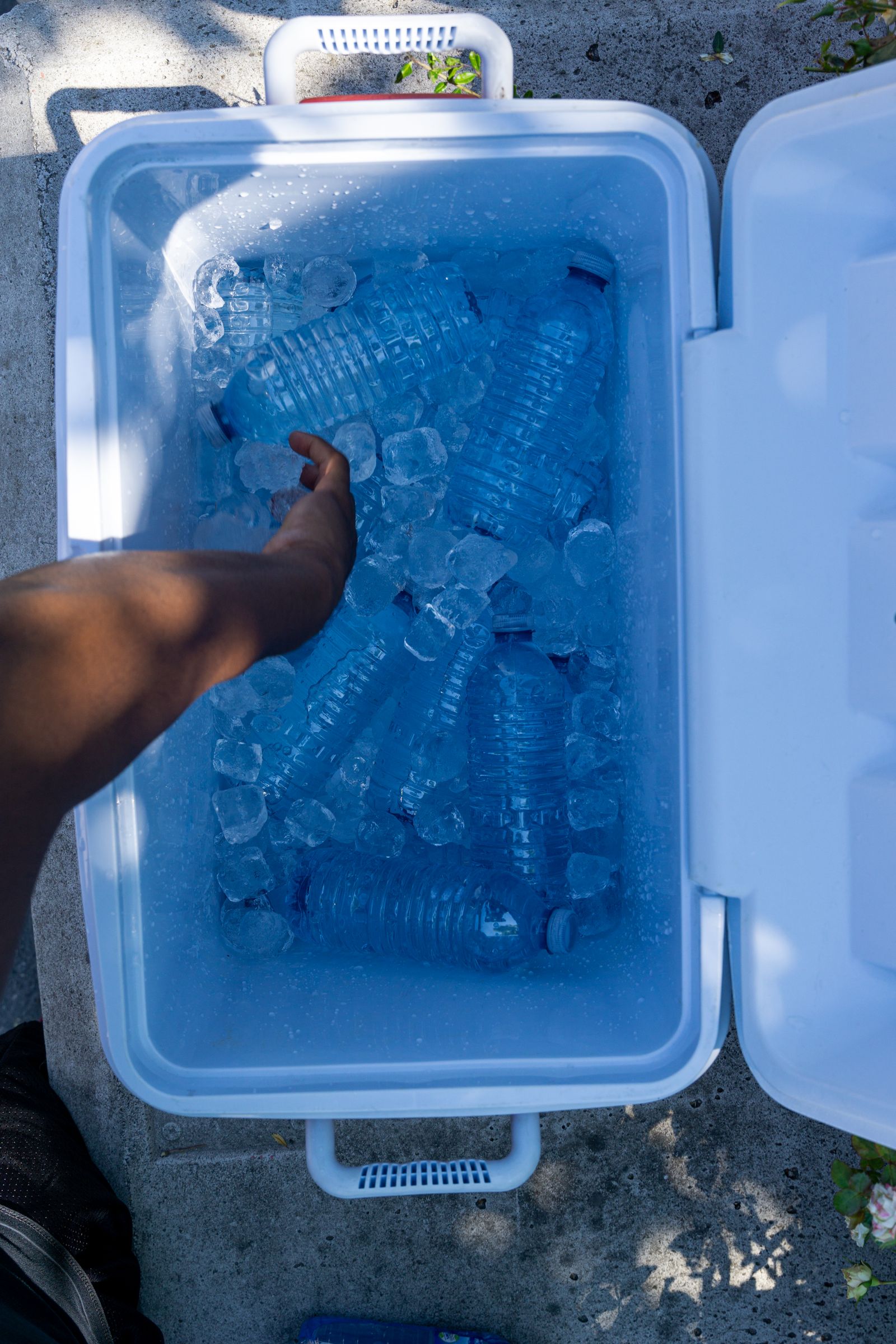
It says cold. Not "access to water." Not "a tap." In a country where the ambient temperature makes tepid water genuinely unpalatable for months of the year, the specification is deliberate. A dispenser that has been out of service for three weeks is not compliance.
The standard is proportionality, not a number. The text says "in proportion to the number of workers" and stops there. There is no litres-per-person figure, no ratio of dispensers to headcount, no walk-distance rule. That gives you flexibility, and it also means you cannot point at a threshold and declare yourself finished. The test is whether the provision is genuinely adequate for the number of people on the floor — which is a question a facilities manager can answer honestly, and an auditor can disagree with.
It is an administrative decision, not a statute. This is guideline-level instrumentation of the Labour Law's general safety duty. It is binding, but it is not the same weight of instrument as an article of the Decree-Law, and it is not accompanied by the kind of prescriptive schedule you would find in UK or EU workplace regulations.
If you are already running a managed hydration programme, you are comfortably past this bar. If your "water provision" is a single cooler on a floor of 80 people that runs dry by Tuesday, the proportionality wording is not on your side.
The dining area requirements — more specific than anyone expects
Article 4(2)(p), "Workplace Facilities," is the part that surprises people. These are the requirements for dining areas, quoted directly:
- "Establish a designated dining area that is suitable for eating, with adequate lighting and ventilation. Fine mesh wire must be installed in the windows of the dining areas."
- "Maintain a proper level of cleanliness in the dining areas."
- "Make sure that the dining areas are equipped with an adequate number of washing basins and cleaning materials."
- "Place waste bins with tight lids in dining areas and dispose of garbage on a timely basis."
- "Establish separate dining areas for female employees."
And for rest areas: located near the workplace, adequate and convenient furniture, adequate lighting and air conditioning, cleanliness maintained, and separate rest areas allocated for female workers.
A few honest observations. Some of this drafting is clearly written with labour accommodation and industrial settings in mind — the fine mesh wire on windows is not a natural fit for a sealed, centrally air-conditioned tower where the windows do not open at all. The separate-facilities-for-female-employees provisions are similarly framed for a different kind of workplace, and how they are applied in a corporate office environment is a question worth putting to your PRO or legal counsel rather than one to resolve from a blog post.
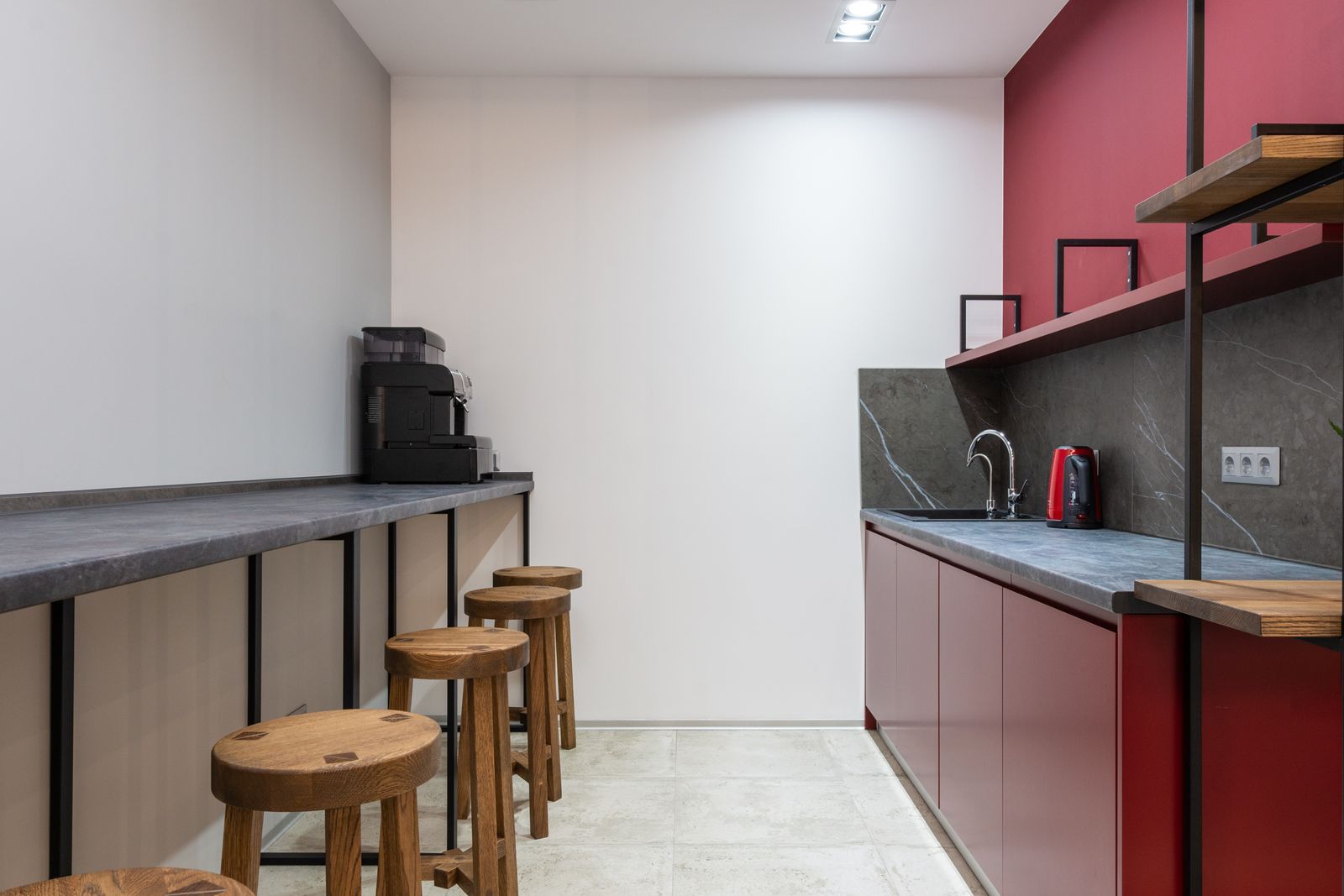
But the operational core translates directly and is not ambiguous at all: a designated eating space, properly lit and ventilated, kept clean, with enough washing basins and lidded bins. That is a pantry specification. Most UAE offices meet it comfortably. The ones that do not usually fail on the same two points — bins without lids, and a cleaning cadence that does not survive a busy month.
If you are building or refitting a space, our new office pantry setup checklist covers the practical layout decisions alongside these requirements.
The 5-hour break rule — and a citation to get right
There is a widely repeated claim that the UAE Labour Law's break entitlement sits in Article 17. It does not. Article 17 is Working Hours (a maximum of 8 hours per day or 48 per week). The break rule is Article 18, "Consecutive Working Hours":
"The worker may not work for more than (5) five consecutive hours without a break or breaks of not less than an hour in total, provided that these periods are not included in the working hours."
Article 18 goes on to allow shift establishments and certain job categories — field roles, for example — to arrange hours and breaks under the Implementing Regulation.
The relevance to the pantry is straightforward. The law contemplates that people stop working for at least an hour in a standard day, and Article 4(2)(p) requires somewhere suitable for them to eat when they do. The pantry is not incidental to that; in most offices it is the facility.
The midday break: what the binding text actually says
Every summer the midday break generates a round of coverage, and every summer the detail gets slightly overstated. Worth getting right if you operate any outdoor, logistics, or facilities headcount alongside your office staff.
The rule: work under direct sun and in open places is prohibited from 12:30 to 15:00, from 15 June to 15 September. Those dates and times are fixed by Ministerial Resolution No. 44 of 2022 and have been identical every year; 2026 is the twenty-second consecutive year of enforcement, now branded by MoHRE as the Occupational Heat Stress Prevention Policy. Compliance has been reported above 99% for several consecutive years.
What is actually required during the break — Administrative Decision 19/2023, Article 11, verbatim:
"Employers are required to provide shaded areas for their workers to rest during rest periods."
That is the general obligation: shade. The more detailed provisions — enough cold drinking water for the number of workers, "hydration fluids, such as lemon juice and minerals, approved by the country's health authorities," on-site first aid, sufficient air conditioning, canopies and sun shades — attach specifically to work that continues through the break under a technical exemption (concrete pouring and asphalt work, emergency utility repairs, permitted 24-hour works).
Two small corrections worth carrying, because both circulate widely:
- The legal text says "hydration fluids, such as lemon juice and minerals." The word electrolytes comes from a MoHRE press release, not the decision. MoHRE's own midday break guidance page omits it entirely.
- The AED 5,000 per worker penalty, capped at AED 50,000 per case, is very widely reported in UAE press and HR commentary. We were not able to locate it in the primary decision text, so treat it as strongly indicated rather than verified from source.
Also note that Ministerial Resolution No. 44 of 2022 is only seven articles long and covers the health and safety officer appointment, the midday ban, and labour accommodation. It contains no drinking water requirement — a point that a number of secondary summaries get wrong by merging it with Administrative Decision 19/2023.
Food safety: the honest grey area
This is where a lot of UAE office-pantry content asserts far more than the sources support.
Dubai's Food Code 2.0 applies to establishments in Dubai — including free zones — that "import, sell, offer for sale, or distribute free of charge, package, prepare, display, serve, manufacture, process, or distribute food." That "distribute free of charge" wording is what makes people nervous about a stocked staff pantry.
But here is what we found on close reading, and it is genuinely inconclusive:
- The word "pantry" appears zero times in the Food Code. There is no explicit inclusion of staff pantries, and no explicit exemption either.
- The Code's stated focus lists food service operations in institutions and canteens — a staff pantry is not named.
- Where the Code does apply, the obligations are real: food handlers need medical fitness testing and occupational health cards; all food handlers must be formally trained by a Food Safety Department-approved provider, with refresher training after two years; there must be a certified Person in Charge; and establishments must operate a fully implemented HACCP plan built on Codex Alimentarius principles.
- One further caution: the version of Food Code 2.0 published as a PDF is watermarked "Final Draft" on every page. Check with Dubai Municipality for the current published edition before relying on section numbers.
In Abu Dhabi, Essential Food Safety Training (EFST) is mandatory for food handlers under Food Law No. 2 of 2008 and Resolution No. 6 of 2020 — a six-hour course delivered by accredited centres, with ADAFSA reporting 39,000 trainees in 2025.
So does a staff-only office pantry need a food permit? We could not find a source — primary or secondary — that says it does, or one that says it does not. The figures for occupational health card and PIC certificate costs that circulate online come from business-setup marketing sites, not from Dubai Municipality.
The defensible position: the further your pantry moves from tea, coffee and packaged snacks toward buffets, catered meals, or on-site cooking, the closer you get to obligations Dubai Municipality has clearly defined. If you are in that territory, confirm your position with DM's Food Safety Department rather than a checklist. Our guide to food safety rules for UAE office pantries covers the operational hygiene practices that are sensible regardless of where the licensing line falls.
What the green building codes do not cover
This is the finding that surprised us most, and it reframes the whole question.
Dubai's Al Sa'fat has been mandatory since 19 October 2020, replacing the earlier Dubai Green Building Regulations, with Silver as the mandatory baseline tier. It sets water efficiency requirements — kitchen sinks at 7 litres per minute, hand wash basins at 6, showerheads at 8 — and it makes Legionella control in building water systems mandatory for both new and existing buildings.
Abu Dhabi's Estidama Pearl Building Rating System works similarly: mandatory Precious Water credits, a 6 l/min kitchen sink faucet baseline, sub-metering that explicitly lists kitchen and catering facilities, and a mandatory Legionella prevention credit.
And in both documents, the word "pantry" appears zero times. Neither contains a drinking water quality credit, a potable water testing requirement, or any provision about how staff actually access drinking water.
The pattern is consistent: the UAE's two mandatory green building codes regulate water as a resource — flow rates, metering, bacterial control in building plant — and say nothing about the provision or quality of drinking water for the people in the building.
Where the voluntary standards go further
The gap the mandatory codes leave is exactly what the WELL Building Standard addresses, and it is voluntary everywhere in the UAE — no authority mandates or incentivises it.
WELL v2's most pantry-relevant requirement is W06, Drinking Water Promotion. Part 1 requires at least one drinking water dispenser, a minimum of one per floor, within 30 metres walk distance of all regularly occupied floor area and in all dining areas — with bottle-refill capability, or daily cleaning of mouthpieces, guards, aerators, basins and touch points.
Set that beside the federal requirement — "in proportion to the number of workers" — and you can see why WELL gets adopted. It converts a proportionality judgement into a number you can design against and audit.
Also worth knowing if your building is pursuing WELL: the Nourishment preconditions N01 (Fruits and Vegetables) and N02 (Nutritional Transparency) are triggered only if food is sold or provided on a daily basis. A stocked office pantry is precisely that trigger. If your landlord or your own facilities team is chasing WELL certification, the pantry programme stops being a soft benefit and becomes part of the compliance scope.
The UAE had 93 WELL Accredited Professionals as of April 2020. One caution: several large UAE corporates publicised have adopted the WELL Health-Safety Rating, which is a different and lighter instrument than full WELL Certification — the two get conflated regularly.
The practical takeaway
Strip it back and the picture is clear:
- There is a binding floor, and it explicitly covers offices. Cold drinking water proportionate to headcount; a designated, lit, ventilated, clean dining area with adequate washing basins and lidded bins; a furnished, air-conditioned rest area. AD 19/2023, Article 4.
- The mandatory green building codes will not help you here. They regulate litres per minute, not whether your people can get a cold drink.
- Food safety licensing for a staff-only pantry is genuinely unsettled. The risk rises with complexity — packaged snacks are a different proposition from a catered buffet.
- Everything above the floor is voluntary — and WELL's one-dispenser-per-floor, 30-metre rule is the most useful benchmark available, whether or not you ever certify.
Most well-run UAE offices clear the legal floor without thinking about it. The value in knowing where the floor actually is: it moves the pantry conversation out of "perk we defend at budget time" and into the same category as lighting, ventilation and washroom provision — an operational requirement with a citable basis. That is a materially stronger position to argue from, and it pairs with the retention and wellbeing case rather than replacing it.
The midday break obliges employers to provide cool water, shade and rehydration provisions for staff working outdoors; the coconut water and electrolyte drinks guide covers what those provisions should actually be, why the need does not stop on the last day of the break, and what they cost.
For the practical side of meeting the drinking-water duty, the water filtration and point-of-use dispensers guide covers building tanks, filter stages and a service schedule for dispensers.
Frequently asked questions
Is an employer legally required to provide drinking water in a UAE office? Yes. MoHRE's Administrative Decision No. 19 of 2023, Article 4(2)(q), requires the provision of cold drinking water in proportion to the number of workers, in accordance with public health and safety requirements. Article 1 of the same decision defines the occupational environment to explicitly include offices.
How much drinking water must be provided per employee? The decision does not specify a figure. The standard is proportionality to headcount, not a litres-per-person threshold. For a designable benchmark, the voluntary WELL v2 standard (W06) sets one dispenser per floor within 30 metres of all regularly occupied space.
Does UAE law require a dedicated staff dining area? Administrative Decision 19/2023, Article 4(2)(p) requires a designated dining area suitable for eating with adequate lighting and ventilation, maintained cleanliness, an adequate number of washing basins with cleaning materials, and waste bins with tight lids.
What is the UAE break entitlement, and which article is it? Article 18 of Federal Decree-Law No. 33 of 2021 — not Article 17, which covers working hours. A worker may not work more than five consecutive hours without a break or breaks totalling at least one hour, and those periods are not counted as working hours.
Does the midday break require employers to provide water? The general obligation in Administrative Decision 19/2023, Article 11 is to provide shaded rest areas. The more detailed requirements — cold drinking water, hydration fluids, first aid, air conditioning, canopies — attach to work continuing through the break under a technical exemption. The midday ban itself runs 12:30–15:00, 15 June to 15 September.
Does an office pantry need a food licence in Dubai? This is not clearly settled. Dubai's Food Code 2.0 covers establishments that prepare, serve, or distribute food free of charge, but the word "pantry" does not appear in it, and there is no explicit inclusion or exemption for staff pantries. The obligations become clearly relevant as an operation moves toward catering, buffets, or on-site cooking. Confirm your position with Dubai Municipality's Food Safety Department.
Do Al Sa'fat or Estidama set office pantry requirements? No. Both set water efficiency and Legionella control requirements for building systems — kitchen sink flow rates of 7 l/min under Al Sa'fat and 6 l/min under Estidama — but neither mentions pantries, drinking water quality, or how staff access drinking water.
Is WELL certification mandatory in the UAE? No. WELL is entirely voluntary and no UAE authority mandates or incentivises it. It is worth knowing because its Nourishment preconditions are triggered when food is provided on a daily basis, which a stocked office pantry does.
This article is general information for UAE businesses, current as of 2026, and is not legal advice. Regulatory obligations depend on your emirate, your premises, your licence, and how your pantry actually operates — confirm your position with qualified counsel, MoHRE, or your municipality's food safety authority. Where we could not verify a point from a primary source, we have said so in the text. My Healthy Office supplies corporate offices across the UAE with managed pantry and hydration programmes — consistent cold water provision, scheduled replenishment, and a documented delivery record. To review how your current setup measures against the requirements above, get in touch.