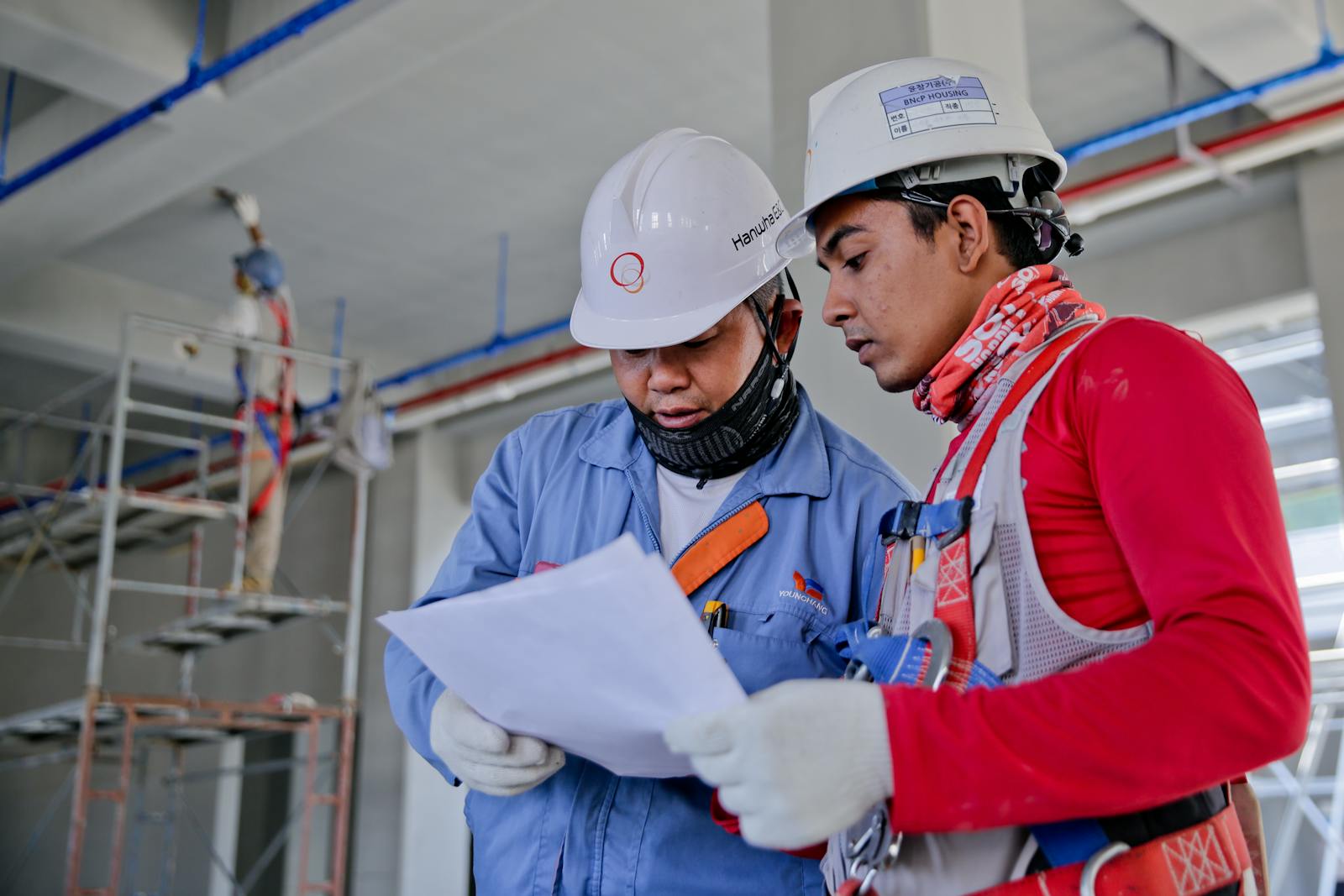
Every other sector in this series buys refreshments for a building. Construction buys them for a programme. A contractor's head office in Business Bay or Mussafah behaves like any other UAE corporate floor, but hanging off it is a rotating set of project site offices — a portacabin cluster at a Dubai South plot, a fit-out team's temporary desk on the fourteenth floor of someone else's tower, a consultant's supervision office beside an Abu Dhabi interchange — each of which appears at mobilisation, runs for twelve to thirty months, and then vanishes.
That single structural fact reshapes everything: how you budget, who approves the spend, how deliveries physically arrive, and what happens to a water dispenser when a project reaches practical completion. This guide is for the office managers, HR leads, procurement teams and project support staff running refreshments inside main contractors, subcontractors, engineering consultancies, MEP firms and project management consultants across the UAE in 2026.
The head office and the site office are two different problems
The most common and most expensive mistake in this sector is procuring for both from one template.
The head office — commercial, estimating, QS, finance, HR, design — keeps conventional hours in a conventional building. It behaves like any other UAE corporate floor and can be planned with ordinary benchmarks; the figures in our office pantry cost per employee guide apply here essentially unchanged.
The project site office is a different species. It is temporary, it may have limited or intermittent power, its population swings by a factor of three between early works and peak construction, its staff are in and out of the cabin all day rather than sitting at a desk, and it sits inside an active construction site with its own access control. A site office also has a genuinely different consumption profile: overwhelmingly weighted toward water and hot drinks, with far less interest in the snack range that a commercial floor works through.
The consultant's supervision office sits between the two — permanent-feeling, client-facing enough that visiting engineers and client representatives pass through regularly, but physically located on or beside the works.
Budget these as one per-head number and you will overspend on the site cabins in the categories they do not use while under-providing the one category they consume in volume. Build the budget as separate lines with separate unit assumptions, and review them separately.
Heat, the midday break, and what the rules actually oblige you to provide
In most sectors, hydration is a comfort question. In construction it is a compliance one, and it is the single area of this pantry where under-provision carries real risk rather than a grumble.
Two things drive it. First, UAE employers carry a duty to provide adequate drinking water to workers, and for site-based staff the practical standard is cold water at the point of work, not a cooler in a cabin four hundred metres away. The obligations and how they translate into actual pantry provision are set out in our guide to UAE labour law and office drinking water. Second, the midday break rule that suspends outdoor work through the peak summer months restructures the working day for every site-based team — and a mandated rest period is only usable if there is shade and water genuinely available where people take it.
The operational consequences are specific:
Put the water where the work is. Dispensers at the site office, the rest shelter and the welfare facilities — not only in the cabin the project manager sits in. A hydration point people have to cross a live site to reach is a hydration point that goes unused.
Size summer volumes properly, and expect them to move. Consumption on a site rises steeply between May and September, and the step is far larger than in an air-conditioned office. A supply arrangement fixed on winter volumes will run short exactly when running short matters most. Our UAE summer office hydration playbook covers the seasonal step-up, and a written corporate hydration policy is worth having on file when you employ site-based staff.
Use bulk dispensed water, not cases of small bottles. At site volumes the per-litre difference is large and the waste difference is larger — and a construction site is not a place where a pallet of 330ml bottles stays tidy. The trade-offs are laid out in our comparison of water coolers versus bottled water.
Plan for power and cooling that is not guaranteed. Early in a project, a site office may be running on a generator with an unreliable supply. Specify dispensers and storage on that assumption rather than the assumption of a stable building supply, and confirm who is responsible for servicing them.
Mobilisation and demobilisation: the pantry has a project schedule
This is the sector's genuinely distinctive procurement problem, and almost no standard pantry arrangement handles it.
A project site office needs to be fully provisioned within days of mobilisation, at a location that did not exist as a delivery address the week before. Eighteen months later it needs to be stood down cleanly — dispensers collected, standing orders stopped, final invoices closed against the right cost code before the project account is settled. In between, its population may triple and then halve.
What this means in practice:
- Site setup should be a defined service, not an improvisation. The new-site provisioning list is broadly stable across projects; our new office pantry setup checklist adapts well to a site cabin, and turning it into a repeatable mobilisation pack saves the same argument being had on every project.
- Standing orders need an end date, or they outlive the project. The most common invisible leak in this sector is a recurring delivery to a site that finished three months ago. A supplier that cannot suspend and close a site cleanly will keep billing you for one.
- Volumes must flex without a renegotiation. Headcount on a site is a curve, not a number. The arrangement should allow the order to scale up and down against actual site headcount rather than a figure agreed at tender.
Cost codes, project accounting and why finance cares
Construction finance does not work like corporate finance. Site costs are charged against project cost codes, and site refreshments are typically a preliminaries item priced at tender and tracked against that allowance for the life of the job.
That has a practical consequence most suppliers never think about: an invoice that bundles head office and four project sites into one undifferentiated line is close to useless to a construction finance team, because it cannot be allocated. Consumption and invoicing split by site is not a reporting nicety here — it is the difference between an invoice that gets processed and one that sits in a queue while someone works out which project it belongs to.
Three things worth establishing up front:
- Per-site invoicing or a per-site breakdown on a consolidated invoice, with a reference field you can map to a cost code or project number.
- Consumption reporting split by site, which is also the only reliable way to distinguish a genuine headcount increase from a leak.
- Pricing held across the project term, so a preliminaries allowance priced at tender is not eroded by mid-project increases. Our guide to office pantry pricing models covers how to structure that, and the payment terms and credit guide is relevant in a sector where payment cycles are long by convention.
If refreshments are being priced into a tender rather than bought ad hoc, our office pantry budget template gives a defensible basis for the preliminaries figure.
Getting a delivery onto an active construction site
Delivering to a tower in DIFC is a logistics problem. Delivering to a live site is an access-control problem.
Depending on the project it can involve site inductions for drivers, gate passes, PPE requirements, vehicle permits, escorted access, defined delivery windows that avoid concrete pours and crane movements, and a main contractor's security regime that a subcontractor's supplier has no standing with. On a fit-out job inside an occupied building, add the landlord's own loading-bay booking system on top.
What to establish before signing anything:
- Has the supplier delivered onto live sites before, and can they name them? "We cover Dubai" is not an answer for a plot in Dubai South.
- Who arranges driver site induction and gate passes, and how long does adding a new driver or site take?
- What is the delivery window, and does it avoid site peak movements?
- What happens when a delivery is refused at the gate — is there a re-attempt commitment, or does the order disappear for a week?
- Can a new site be opened as a delivery address quickly, and what notice does mobilisation need?
If your projects sit inside free zones or master-developer areas, our guide to pantry delivery in Dubai's free zones covers the access mechanics, and work spanning both emirates is worth reading alongside the Abu Dhabi office pantry guide.
Range: a genuinely mixed workforce, and tea matters
UAE construction and engineering employs one of the most internationally mixed professional workforces in the country — a site office typically spans South Asian, Filipino, Arab, and European staff across engineering, QS, HSE and supervision roles, with a different mix again on the head-office commercial floor.
Two implications. Halal provision is a baseline requirement rather than an option, and it needs to be verifiable rather than assumed — our halal compliance guide covers what to ask for. And tea is not a secondary category here: for a large share of this workforce a proper tea offering, karak included, is the daily ritual and coffee is the exception. A considered tea programme is both better received and cheaper per serving than the equivalent coffee spend.
Ramadan needs specific planning, because site programmes and fasting interact awkwardly — working hours shift, the midday break and iftar timing collide with the site schedule, and a supervision team fasting through a summer pour has genuinely different needs. Our guide to healthy fasting at work is a useful starting point.
Multi-site consistency without multi-site cost
A contractor with a head office and five active projects is running six pantries. Left alone, each site will find its own local supplier, at its own price, on its own invoice — and the drift is mostly invisible until someone totals it.
Consolidation is usually the single largest saving available to a multi-project contractor, and the mechanics are covered in our guides to multi-site pantry management and supplier consolidation. The caveat is the same one that applies across this sector: consistency belongs in the commercial arrangement, not the item list. One supplier, one price list, one contract — but a site cabin's range should look nothing like the head-office floor's.
What to specify in a construction pantry supplier
The requirements that actually separate suppliers in this sector:
- Demonstrated live-site delivery experience, including driver inductions, gate passes and PPE compliance.
- Fast site mobilisation — a new project address provisioned within days, and a defined demobilisation process that closes standing orders and recovers equipment.
- Bulk water capability at site volumes, priced per litre rather than per case, with dispenser servicing included and no assumption of stable mains power.
- A summer step-up mechanism that raises hydration volumes seasonally without renegotiation each May.
- Per-site consumption reporting and invoicing with a reference field that maps to a project cost code.
- Price held for the project term, so a tendered preliminaries allowance holds.
- Range flexibility per site, so the site cabin list and the head-office list differ under one agreement.
- Delivery windows that respect site movements rather than colliding with them.
If you are putting the arrangement out formally, our office pantry RFP and tender template adapts well to a multi-project brief, and the mobilisation, access and re-attempt commitments above belong in a written service level agreement rather than in an email thread.
Office pantry guides by industry: Banks & financial services · Consulting & advisory firms · Government & public sector · Healthcare, clinics & hospitals · Law firms & professional services · Logistics & freight · Manufacturing & industrial · Media & creative agencies · Oil, gas & energy · Pharmaceutical & life sciences · Real estate & property · Schools & universities · Tech companies & startups · Coworking spaces · Aviation & airport services · Retail & e-commerce
Frequently asked questions
How is a construction company's office pantry different from a normal corporate pantry? It is not one pantry but several with different lifespans. A permanent head office behaves like any other UAE corporate floor, while each project site office is temporary, sits inside an active construction site with its own access control, has a headcount that swings by a factor of three across the project, and consumes overwhelmingly water and hot drinks rather than the snack range a commercial floor works through. Budgeting them from one template overspends on categories site cabins never touch while under-providing the one they consume in volume.
What are the hydration requirements for site-based staff in the UAE? UAE employers carry a duty to provide adequate drinking water, and for site-based staff the practical standard is cold water available at the point of work rather than a dispenser in a distant cabin. The summer midday break rule that suspends outdoor work through the peak months also means rest areas need usable shade and water. In volume terms, plan a steep seasonal step-up from May to September, place dispensers at the rest shelter and welfare facilities as well as the site office, and use bulk dispensed water rather than cases of small bottles.
How should refreshments be handled when a project mobilises or finishes? Treat site setup as a defined, repeatable service rather than an improvisation: a standard provisioning pack that can be delivered within days of mobilisation to an address that did not exist the week before. Just as important is demobilisation — standing orders closed, dispensers recovered and final invoices settled against the right cost code. A recurring delivery to a site that finished three months ago is the most common invisible leak in this sector.
How should site pantry costs be invoiced for project accounting? Split by site, with a reference field that maps to a project cost code or project number. Site refreshments are usually a preliminaries item priced at tender and tracked against that allowance, so an invoice bundling head office and several projects into one undifferentiated line cannot be allocated and will sit unprocessed. Ask for per-site invoicing or a per-site breakdown on a consolidated invoice, per-site consumption reporting, and pricing held for the project term.
Can pantry suppliers deliver onto an active construction site? Some can, many cannot, and it is the requirement most often underestimated. Live sites can involve driver site inductions, gate passes, PPE requirements, vehicle permits, escorted access and delivery windows that must avoid concrete pours and crane movements — and on a fit-out job, the landlord's loading-bay booking system on top. Before signing, confirm the supplier has delivered onto live sites and can name them, who arranges inductions and gate passes, how quickly a new site can be opened as a delivery address, and what happens when a delivery is turned away at the gate.
For the delivery model built around site offices and project durations, see the office pantry service for construction and engineering, and Mussafah for the Abu Dhabi industrial belt specifically.
The bottom line
A construction pantry is a portfolio, not a place. The contractors who handle it well stop treating it as one budget line and start treating it as two distinct problems: a permanent head office that can be planned with ordinary corporate benchmarks, and a rotating set of site offices with real hydration obligations, unstable populations, hard access control and a finance team that needs every dirham allocated to a cost code. Then they choose a supplier on the three things that actually decide the outcome — can they get through the gate, can they stand a new site up in days and close it cleanly, and can they hold one price list across every project.
My Healthy Office supplies managed pantry, coffee and bulk water programmes to contractors, engineering consultancies and project teams across Dubai, Abu Dhabi and the wider UAE, including multi-project contracts on a single price list with per-site reporting and invoicing. Talk to our team about a programme built for how your projects actually run.