Most office pantry guides — including many on this blog — quietly assume an average office: a predictable nine-to-five, a headcount that maps neatly onto a desk plan, and a pantry that exists to keep staff fed and watered between meetings. A law firm, a strategy consultancy or an audit practice breaks nearly all of those assumptions. The hours are long and spiky, the pantry sits on the same floor a client is walked across, and the person queuing for coffee is billing a rate that makes ten wasted minutes a real number on a real matter. This guide is for the office managers, practice managers and facilities leads running pantries in professional-services firms across the UAE in 2026 — and what a managed pantry has to do differently to work in that setting.
Why a professional-services pantry is a different brief
Four things make the pantry in a law firm or consultancy structurally different from the one in a typical corporate office.
It is client-facing whether you intend it to be or not. In a professional-services office the client comes to you. Prospects are walked from reception to a boardroom, and the route almost always passes the coffee station, the fridge or the counter. Every one of those touchpoints is read — consciously or not — as evidence of how the firm operates. A chipped mug, an empty carafe or a machine with an out-of-order sticker undercuts a pitch in a way a manufacturing floor's pantry never could.
Billable time makes queuing genuinely expensive. In most offices, a few minutes lost at a slow coffee machine is a soft cost. In a firm where fee-earners bill by the six-minute unit, it is a hard one. A pantry that forces a partner or a senior associate to wait, refill, descale or hunt for milk is quietly converting billable hours into unbillable ones. Reliability and throughput are not niceties here; they are a return-on-time calculation.
The hours are long and unpredictable. Deal closings, filing deadlines, audit busy season and litigation crunches produce late nights and weekend work that no fixed restocking schedule anticipates. A pantry stocked for a Monday-to-Friday, nine-to-five rhythm runs dry exactly when the team is under the most pressure — which is precisely when a well-run refreshment offer earns the most goodwill.
The standard is set by the client, not the staff. In an ordinary office you stock for your own people. In a professional-services firm the benchmark is what a client expects to be served in a meeting: proper coffee, still and sparkling water in glass, decent tea, and something credible to put out for a long session. That raises the floor on quality across the whole pantry, because the same counter serves both the internal team and the client in the room next door.
The boardroom is the real product
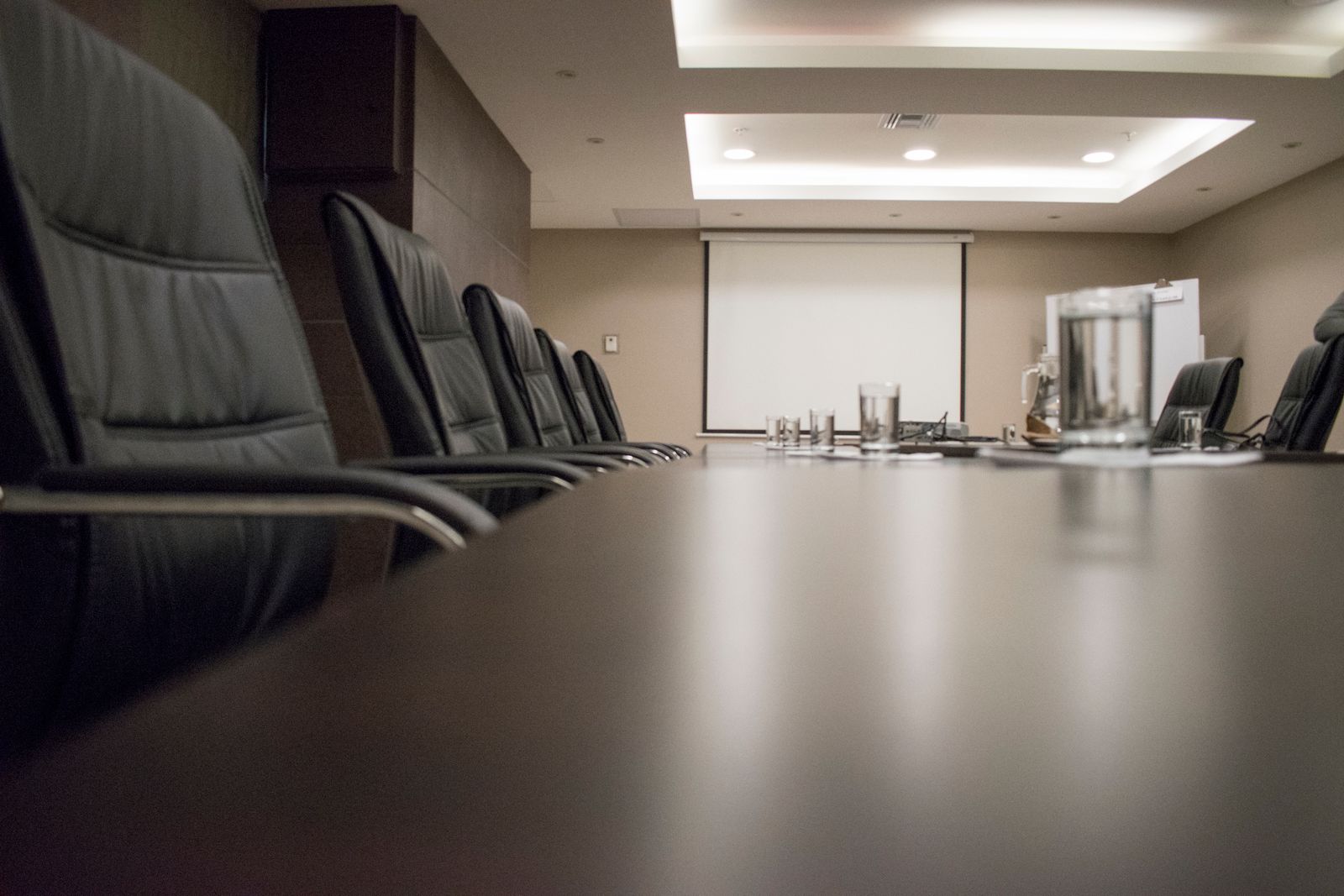
For most professional-services firms, the single highest-value part of the pantry is what reaches the meeting room. This is where the firm is on display and where the cost of getting it wrong is highest.
A few things separate a boardroom offer that reads as considered from one that reads as an afterthought:
- Water in glass, not plastic. Still and sparkling in glass bottles or carafes is the baseline expectation for a client meeting in a UAE professional-services office. It is a small line item that carries disproportionate signal. Our premium water and beverages for the boardroom guide covers the options and the etiquette in more detail.
- Coffee that can be made without a scene. A partner should be able to produce two good coffees for a client without descaling a machine or apologising for it. That points to the right equipment and a service that keeps it running — see our guides to the best office espresso machines in Dubai and to running an office coffee program that holds up under real use.
- Something to put out for a long session. Deals and audits run long. A credible spread — fresh items in the morning, a considered snack offer through the afternoon — is part of the hospitality a client remembers. Our note on B2B catering and fresh bakery for morning meetings is a useful starting point.
- Dietary and allergen awareness. Client meetings in the UAE routinely include a range of dietary requirements, and getting this right is both courtesy and, increasingly, compliance. See allergen and dietary labelling for UAE corporate pantries.
The practical implication: treat the boardroom refreshment offer as a distinct tier of the pantry with its own standard, not as whatever happens to be left in the general fridge.
Stocking for the long-hours reality
The defining operational challenge in professional services is that demand does not follow the calendar. Busy season, deal timelines and filing deadlines create predictable-but-irregular spikes, and the pantry has to be there during them.
Three things help:
Buffer stock sized to the crunch, not the average. A pantry stocked only to average daily consumption runs out during exactly the weeks it matters most. Building in headroom on coffee, water, and the core snack range — and agreeing that headroom with your supplier in advance — costs a little in carrying stock and saves a lot in a 9pm run to the shop during a closing.
A restocking cadence that can flex. A fixed weekly delivery is fine for the base load, but professional-services demand needs a supplier who can respond between scheduled visits when a matter blows up. This is where the service model matters more than the price list. Our guide to multi-site and responsive pantry management covers how to structure this.
Caffeine and hydration as the two non-negotiables. When the hours get long, the two things that must never run out are coffee and water. Everything else in the pantry can flex; these two cannot. In the UAE's climate, hydration in particular is not optional — our corporate hydration playbook sets out why it matters and how to plan for it.
The cost question, done properly
Professional-services firms are, by temperament, good at scrutinising cost — but the pantry is one place where a purely per-item view leads the analysis astray. The right lens is not the unit price of a coffee capsule; it is the fully loaded cost per employee against the value of the time and goodwill the pantry protects.
Two framings are worth holding in mind:
- Cost per employee, not cost per line item. A pantry budget is best understood on a per-head basis, benchmarked against comparable firms, so you can see whether you are under- or over-provisioning. Our cost per employee and pricing models guides give the UAE benchmarks and the commercial structures to expect.
- The opportunity cost of billable time. This is the framing unique to professional services. If a reliable, well-run pantry saves each fee-earner even a few minutes a day of not chasing coffee, milk or a working machine, the arithmetic against their billable rate dwarfs the difference between a mid-range and a premium supply contract. Reliability is the value; the consumables are almost a rounding error next to it.
The conclusion most professional-services firms reach is that the cheapest pantry is rarely the best value, and that the real saving comes from a service reliable enough to remove the pantry from the list of things anyone has to think about.
Procurement and compliance: DIFC, ADGM and VAT
Many of the UAE's professional-services firms sit inside the financial free zones, and that shapes both where you buy and how you account for it.
DIFC and ADGM procurement standards. Firms in the financial free zones often operate under procurement and vendor-onboarding standards stricter than those elsewhere, and a pantry supplier has to be able to meet them — proper trade licensing, documentation, food-safety credentials and invoicing. Our comparison of DIFC vs ADGM office pantry procurement and compliance walks through what each expects.
VAT treatment of staff and client refreshments. The VAT position on pantry supplies — and the distinction between staff refreshments and client hospitality — is something a professional-services finance team will want handled correctly. Our guide to VAT on office pantry and staff refreshments sets out the treatment.
Food safety as a baseline, not an extra. Client-facing catering raises the stakes on food safety and hygiene. A supplier should treat compliance with the relevant UAE municipality food-safety rules as a given — see food safety rules for the office pantry.
Get the service level in writing
The single most useful thing a professional-services office manager can do is stop buying the pantry on a price list and start buying it on a service level. A firm that scrutinises its own engagement letters for a living should hold its suppliers to the same standard.
An SLA suited to a professional-services office should pin down the things that actually go wrong: response time when something runs out mid-week, maximum downtime on the coffee equipment, restock frequency and the flex around it, the boardroom standard specifically, and a named contact who answers when a deadline collides with an empty fridge. Our office pantry SLA template gives a starting structure, and if you are going to market properly, our RFP and tender template will help you compare suppliers on service rather than headline price.
Office pantry guides by industry: Banks & financial services · Construction & engineering · Consulting & advisory firms · Government & public sector · Healthcare, clinics & hospitals · Logistics & freight · Manufacturing & industrial · Media & creative agencies · Oil, gas & energy · Pharmaceutical & life sciences · Real estate & property · Schools & universities · Tech companies & startups · Coworking spaces · Aviation & airport services · Retail & e-commerce
Dedicated programme: See how MHO supports law firms and professional services across the UAE with discreet, client-floor-ready pantry service.
Advisers who work closely with private clients may also find the family office pantry and hospitality guide useful.
Frequently asked questions
What makes a law firm's pantry brief different from a normal office's? Four things. It is client-facing whether you intend it or not, because prospects are walked from reception to a boardroom past the coffee station. Billable time makes queuing genuinely expensive when fee-earners bill by the six-minute unit. The hours are long and unpredictable around deal closings, filing deadlines and audit busy season. And the standard is set by the client rather than the staff, which raises the quality floor across the whole pantry.
What does a credible boardroom refreshment offer include? Still and sparkling water in glass bottles or carafes rather than plastic — a small line item carrying disproportionate signal. Coffee a partner can make for a client without descaling the machine or apologising for it. Something to put out for a long session: fresh items in the morning and a considered snack offer through the afternoon. And genuine dietary and allergen awareness, which in UAE client meetings is both courtesy and increasingly compliance.
How do you stock for busy season without over-buying year-round? Size buffer stock to the crunch rather than the average, and agree that headroom with your supplier in advance — it costs a little in carrying stock and saves a lot in a 9pm run to the shop during a closing. Pair it with a restocking cadence that can flex between scheduled visits when a matter blows up. Coffee and hydration are the two things that must never run out; everything else can flex.
How should a professional-services firm judge pantry cost? On fully loaded cost per employee benchmarked against comparable firms, not on the unit price of a coffee capsule — and against the opportunity cost of billable time. If a reliable pantry saves each fee-earner even a few minutes a day of chasing coffee, milk or a working machine, the arithmetic against their billable rate dwarfs the difference between a mid-range and a premium supply contract. Then buy it on a written service level rather than a quote.
Client meetings in a firm's own rooms are where the pantry becomes visible to the people paying for the advice; the corporate breakfast and meeting catering guide covers the client configuration, the Arabic coffee and dates that a GCC counterparty notices the absence of, and the service-lift access that decides whether it arrives on time.
The short version
For a UAE law firm, consultancy or accountancy, the pantry is not a back-office cost line — it is a client-facing surface, a protector of billable time, and a piece of the firm's professional standard that a prospect reads on the walk from reception. Stock it for the crunch rather than the average, treat the boardroom as its own tier, judge cost against the value of the time it saves rather than the price of a capsule, and buy it on a written service level rather than a quote. Get those four things right and the pantry stops being something anyone in the firm has to think about — which, in a practice that bills by the minute, is exactly the point.
My Healthy Office supplies managed office pantry, coffee and refreshment programmes to professional-services firms across Dubai, Abu Dhabi and the wider UAE — including client-facing boardroom service built for firms where the pantry meets the client. Talk to us about your office.